
The battle for onchain dominance is now a full-blown institutional land grab. Legacy titans have stopped watching; they are filing trademarks, launching staking funds, and killing the friction of the T+2 world. With regulators ending turf wars and exchanges turning stocks into code, the signal is clear: if your capital isn’t 24/7 and onchain, it’s already obsolete.
✔️ Banks file stablecoin trademarks and launch institutional staking ETFs.
✔️ Exchange partnerships unlock 24/7 programmable stock trading.
✔️ Federal agencies synchronize as states pass the first stablecoin laws.
Ready for the signals? 🔍
🚨 Featured Story of the Week:
February Funding Roundup: Architecture for the New Money Era
How is venture capital quietly re-engineering global finance? Our February deep dive reveals a massive shift from speculative apps to the deep infra of the onchain economy. The focus has moved to building the stablecoin rails and compliance engines necessary for the next trillion dollars of institutional capital.
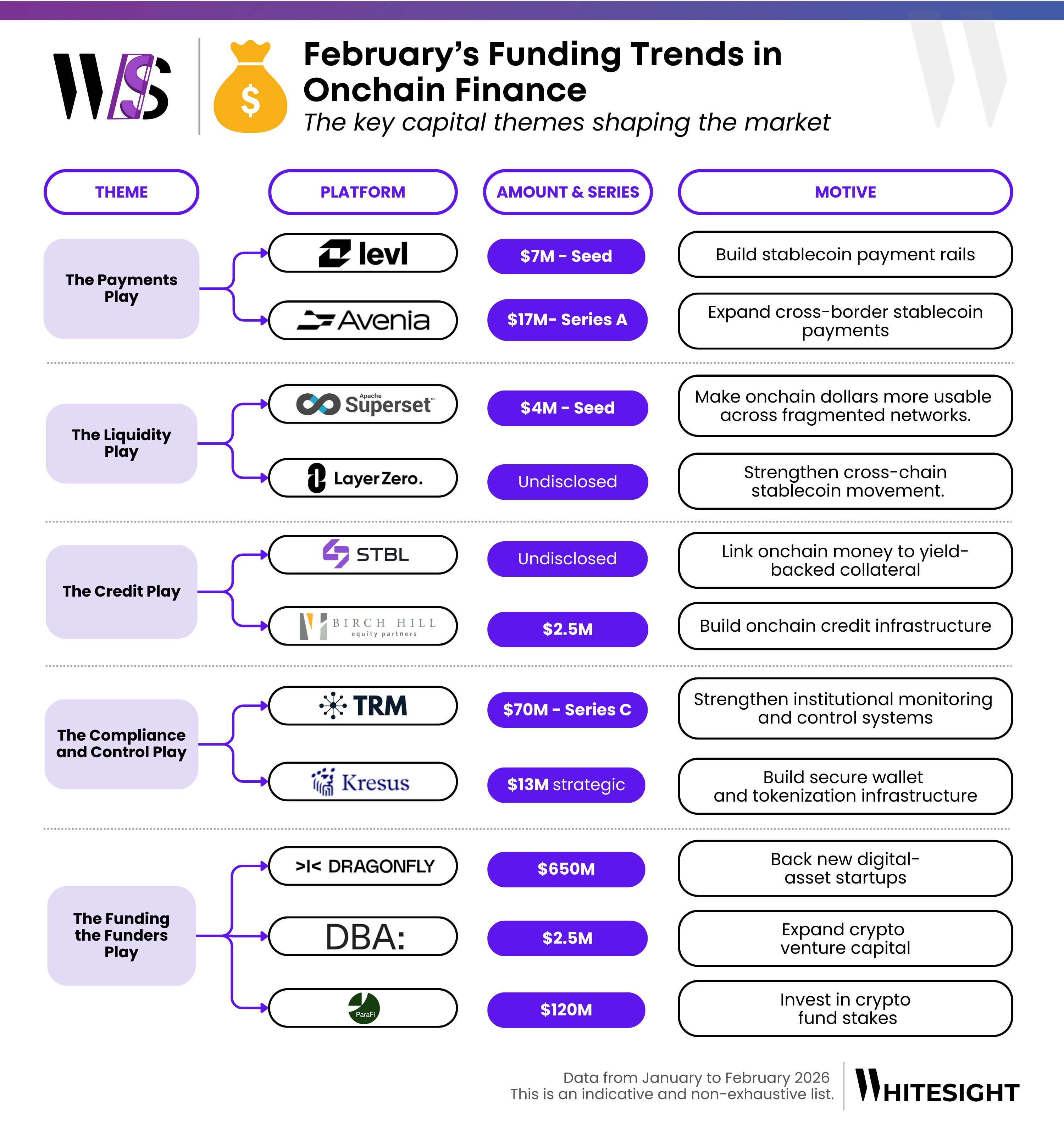
Breaking it down the five strategic themes:
The Payments & Liquidity Play: Levl and Avenia are scaling stablecoin rails, while LayerZero unifies fragmented liquidity across chains.
The Compliance Frontier: TRM Labs’ $70M raise highlights that institutional monitoring is now the bedrock of any regulated onchain strategy.
The Credit Architecture: Platforms like STBL and Birch Hill are transforming onchain money into yield-backed, productive collateral.
The Compliance & Control Play: Kresus and TRM are securing the “entry points” for institutions through secure wallets and control systems.
Funding the Funders: Heavyweights like Dragonfly ($650M) and Pantera are reloading war chests to accelerate the next phase of blockchain-native startups.
Check out the full breakdown and join the conversation here »»
🚀 Startup Spotlight: Cryptio
Cryptio is bridging the gap between decentralized ledgers and traditional finance by providing a robust crypto ERP layer for the institutional world. By integrating directly with established systems like NetSuite and Oracle, Cryptio allows banks, exchanges, and corporations to manage digital assets with the same accounting rigor as fiat currency.

The firm recently reached a significant milestone by securing $45 million in Series B funding, capital that was largely provided by a syndicate of high-conviction crypto and fintech backers. The round saw heavy participation from crypto-native powerhouses like 1kx, BlueYard Capital, and Ledger Cathay, and will be used to accelerate Cryptio’s expansion into regulated loan and treasury management tools.
Building something interesting in onchain finance? We’d love to feature you next- drop us a note at hello@whitesight.net 👋
Pledge your access to fintech analysis and exclusive insights ⚡
📢 We’re always seeking innovative voices in fintech to be our next guest feature!
With a community of 2100+ fintech enthusiasts, we’d love to amplify your insights. Reach out to us for features, sponsorships, or collaborations!
Get Unlimited Access to Strategy Playbooks of Fintech Pioneers with WhiteSight Radar! 🚀

Unlock a treasure trove of fintech intel with a WhiteSight Radar subscription. See further with exclusive reports, industry trend breakdowns, and expert analysis on everything from Embedded Finance and Digital Banking to Open Finance and beyond.
Become a member and steer your business course with actionable intelligence on the winning strategies of leading companies like Apple, Stripe, Starling Bank, OakNorth Bank, Banco Inter, and Toast that propels your business to the forefront of fintech. (PLUS! More in our premium content pipeline - Amazon, Nubank, Grab, Wise, Shopify, Affirm, Mercado Libre… the list goes on!)
Supercharge your Fintech IQ with WhiteSight Radar, putting expert fintech intel at your fingertips! 🧭
Edition 7: The signals defining the new era of money, markets, and assets »
Last Week’s Top Onchain Tea!♨️
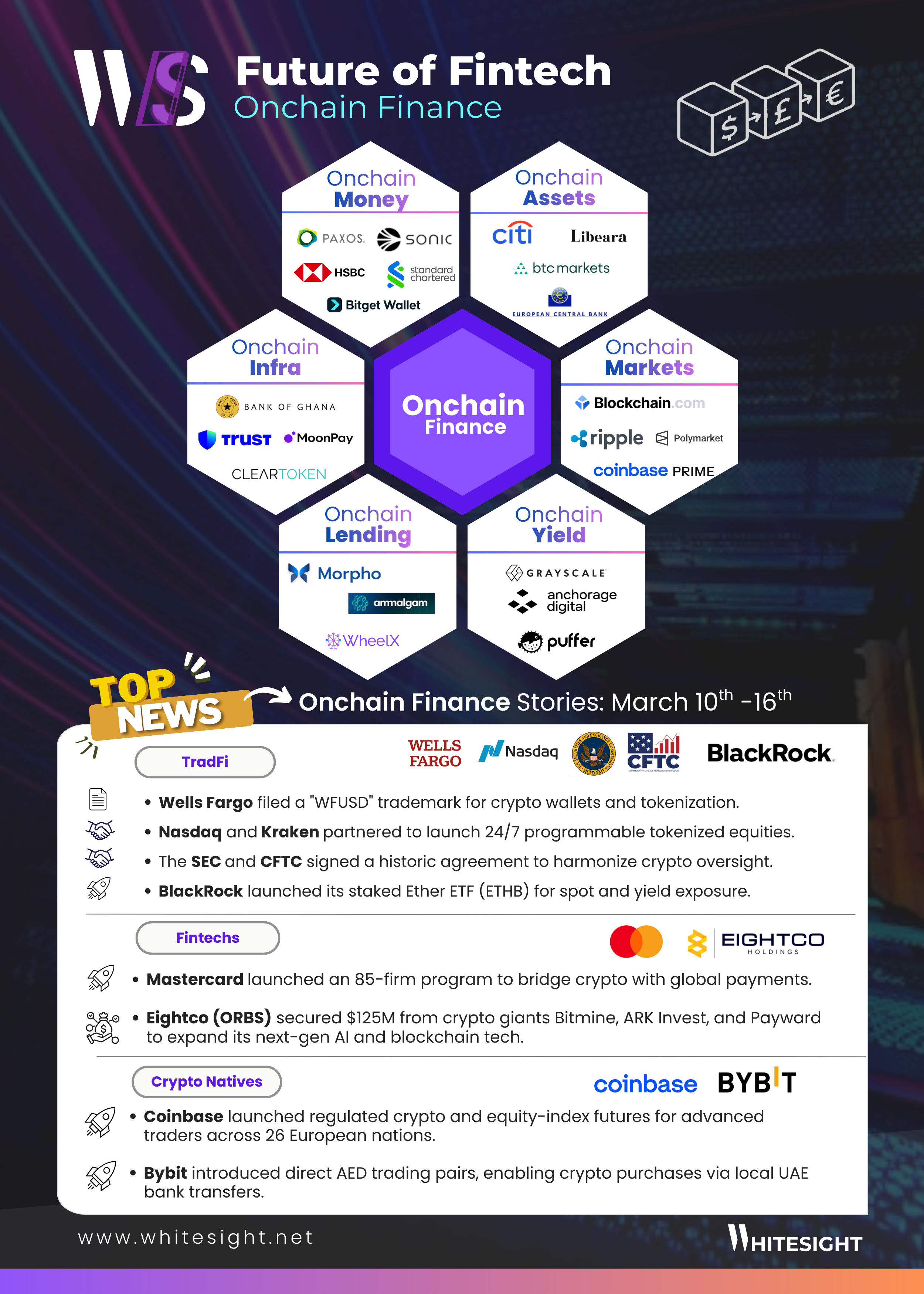
Traditional giants pivot from observation to integration
↳ Wells Fargo filed a WFUSD trademark covering crypto wallets and tokenization, signaling a major move toward bank-issued stablecoins and digital payments.
↳ The SEC and CFTC signed a historic coordination agreement to harmonize digital asset oversight, ending years of jurisdictional overlap and providing a clear rulebook for US institutions.
Global networks scale through regulated infrastructure and local rails
↳ Mastercard launched a massive Crypto Partner Program with 85+ firms to bridge digital assets with global payment networks and real-world merchant rails.
↳ Bybit introduced direct AED trading pairs funded via local UAE bank transfers, deepening the integration between crypto markets and regional sovereign currencies.
Tokenized equities and futures bridge the gap for global traders
↳ Nasdaq and Kraken partnered to launch 24/7 programmable tokenized equities, allowing stocks to trade with the speed and flexibility of onchain assets.
↳ Coinbase secured regulatory approval to launch crypto and equity-index futures across 26 European nations, significantly expanding its institutional derivatives footprint.
Institutional yield and AI-driven growth draw record capital
↳ BlackRock debuted its Staked Ether ETF (ETHB), allowing investors to capture both Ethereum’s price appreciation and its native staking rewards in one fund.
↳ Eightco (ORBS) secured $125M in institutional funding led by Bitmine, ARK Invest, and Payward to accelerate the development of next-generation AI and blockchain infrastructure.
Now, for the ‘byte’-sized onchain buzz -
Onchain Money
Stablecoin regulation is shifting from federal debates to state-level action and clarified insurance boundaries.
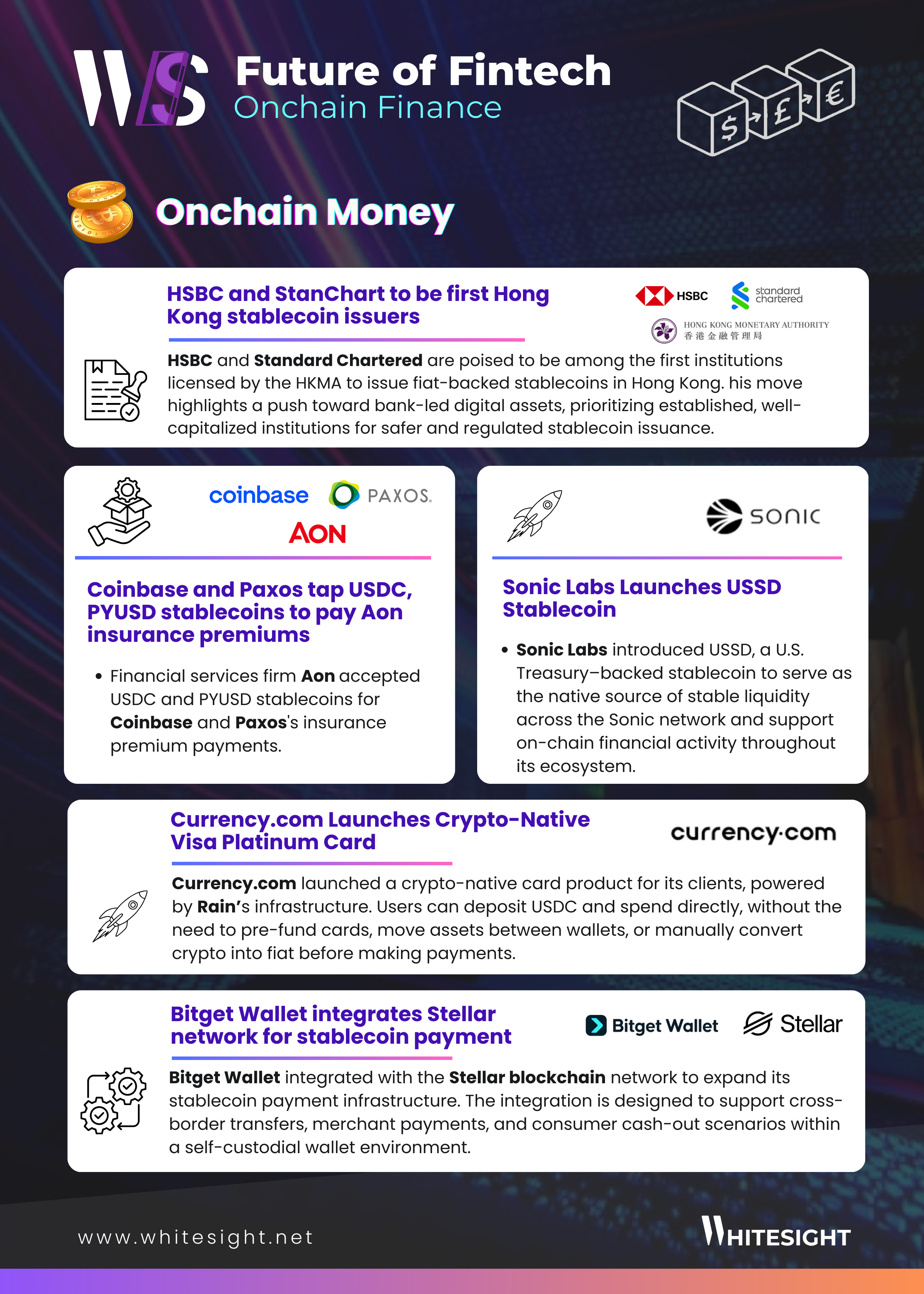
The News: Florida became the first US state to pass a comprehensive stablecoin regulatory bill, establishing a clear legal framework for issuers within the state.
Implication: State-led regulation creates a laboratory for stablecoins; Florida’s move could force a federal standard as more states seek to attract digital dollar issuers.
The News: The FDIC officially ruled out deposit insurance for stablecoins under the Genius Act, confirming they will not be treated like traditional bank deposits.
Implication: This draws a hard line between bank money and stablecoin money, pushing issuers to prove their stability through 1:1 reserves and transparency rather than government backstops.
Onchain Assets
The tokenization wave is turning into a licensed reality as global platforms secure the permits needed to move trillions onchain.
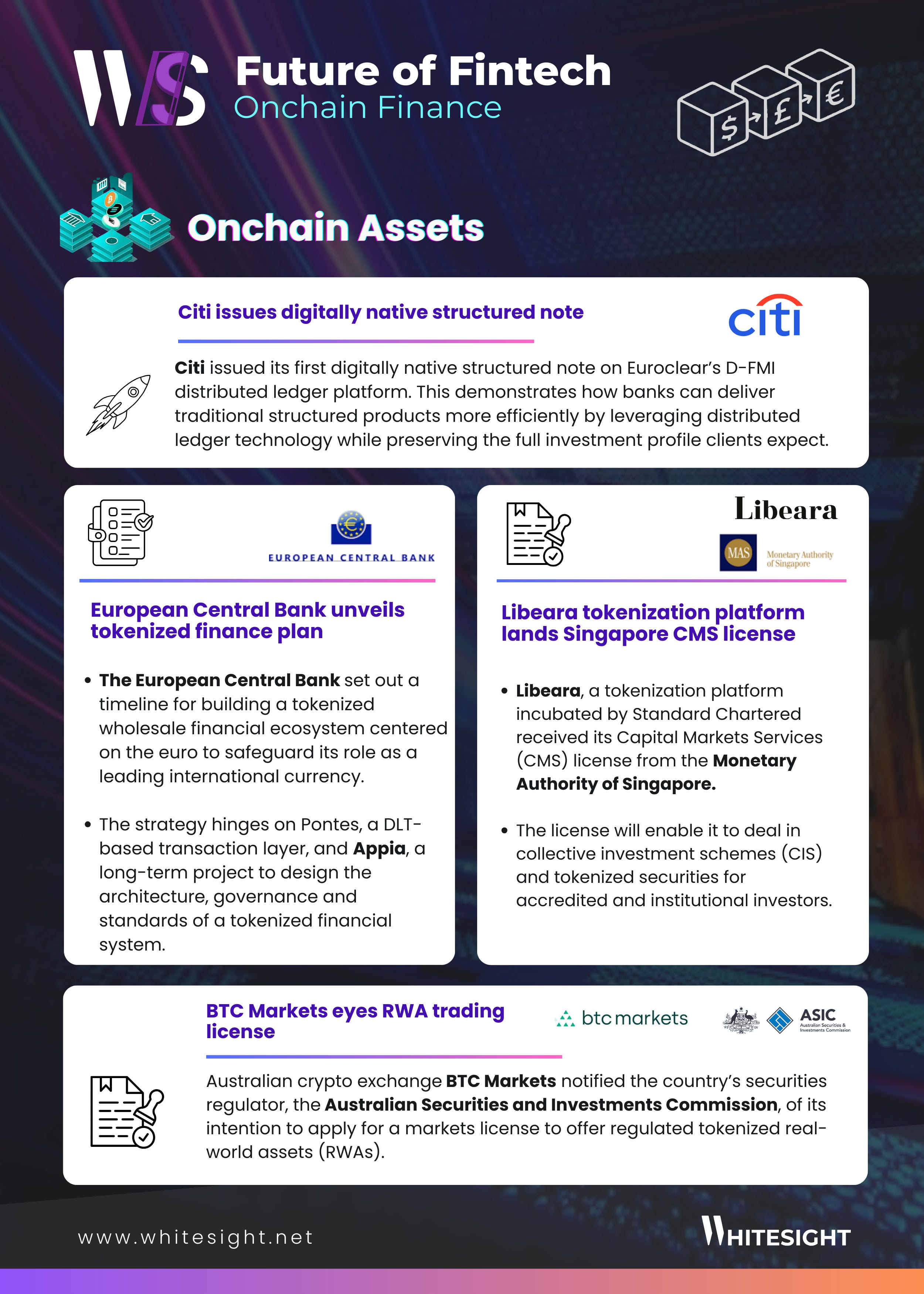
The News: Standard Chartered’s Libeara platform secured a Capital Markets Services (CMS) license in Singapore to facilitate institutional asset tokenization.
Implication: One of the world’s largest banks now has a regulated green light to bring traditional securities onchain, legitimizing RWAs for the world’s most conservative wealth managers.
The News: BTC Markets is aggressively pursuing an RWA trading license to meet growing investor demand for tokenized real-world assets.
Implication: Native crypto exchanges are evolving into multi-asset platforms, signaling that the future of trading is anything that can be tokenized.
Onchain Markets
Prediction markets and blockchain-based securities are becoming the new standard for institutional hedging and settlement.
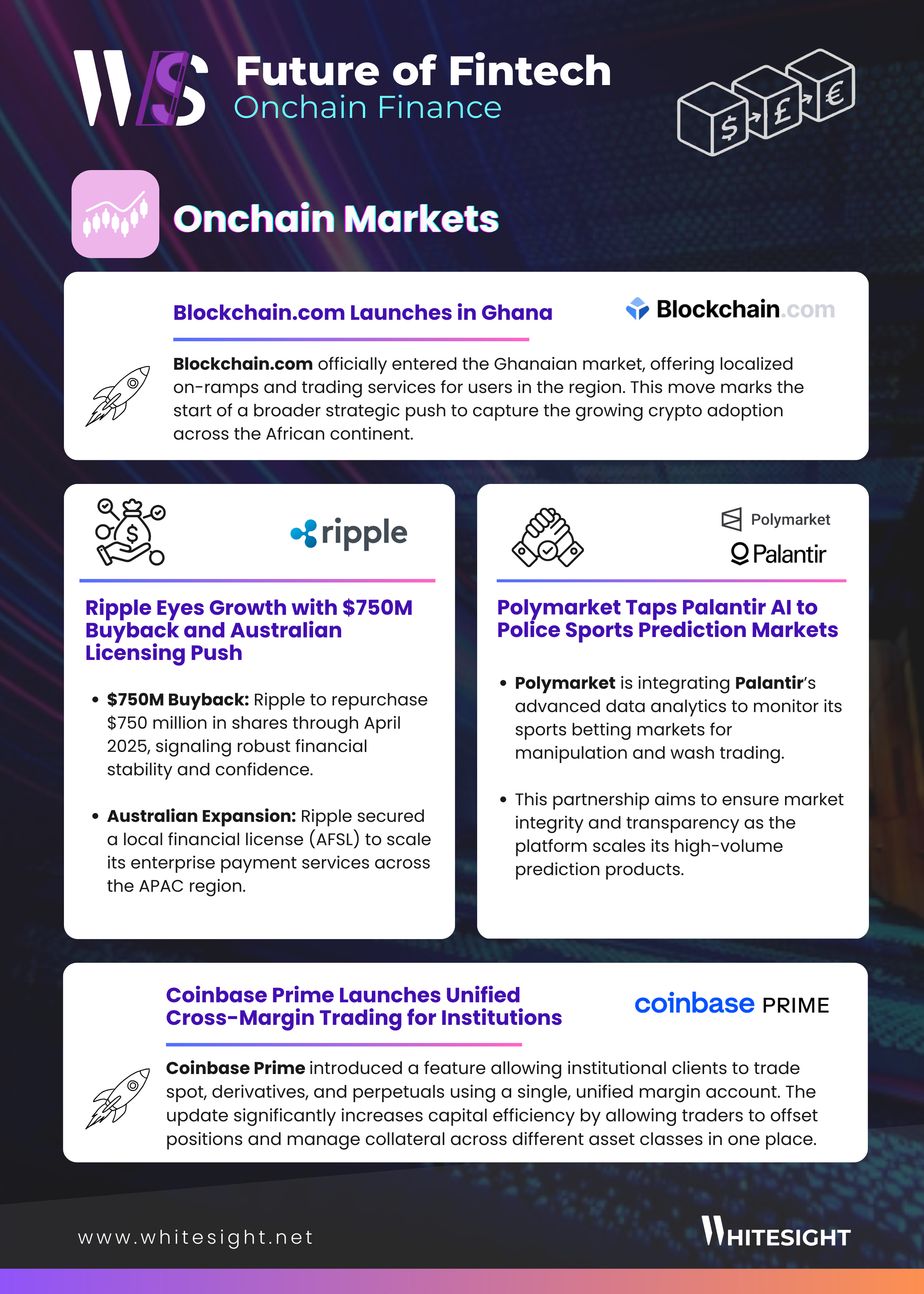
The News: Prime brokers are moving to open Kalshi’s regulated prediction markets to institutional hedge funds for high-stakes event hedging.
Implication: Prediction markets are graduating from retail ‘betting’ to professional ‘hedging’ tools, providing a more accurate real-time gauge of global risk than traditional polling.
The News: Swiss crypto bank Amina become the first fully regulated bank to join 21X for tokenized securities operating under the European Union’s DLT pilot regime, marking another step toward integrating digital asset infrastructure with traditional capital markets.
Implication: The collaboration aims to address a key barrier to institutional adoption of tokenized assets by connecting regulated banks with the issuance and trading of tokenized securities.
Onchain Infra
The backend of the digital economy is being fortified with institutional-grade custody and advanced security layers.
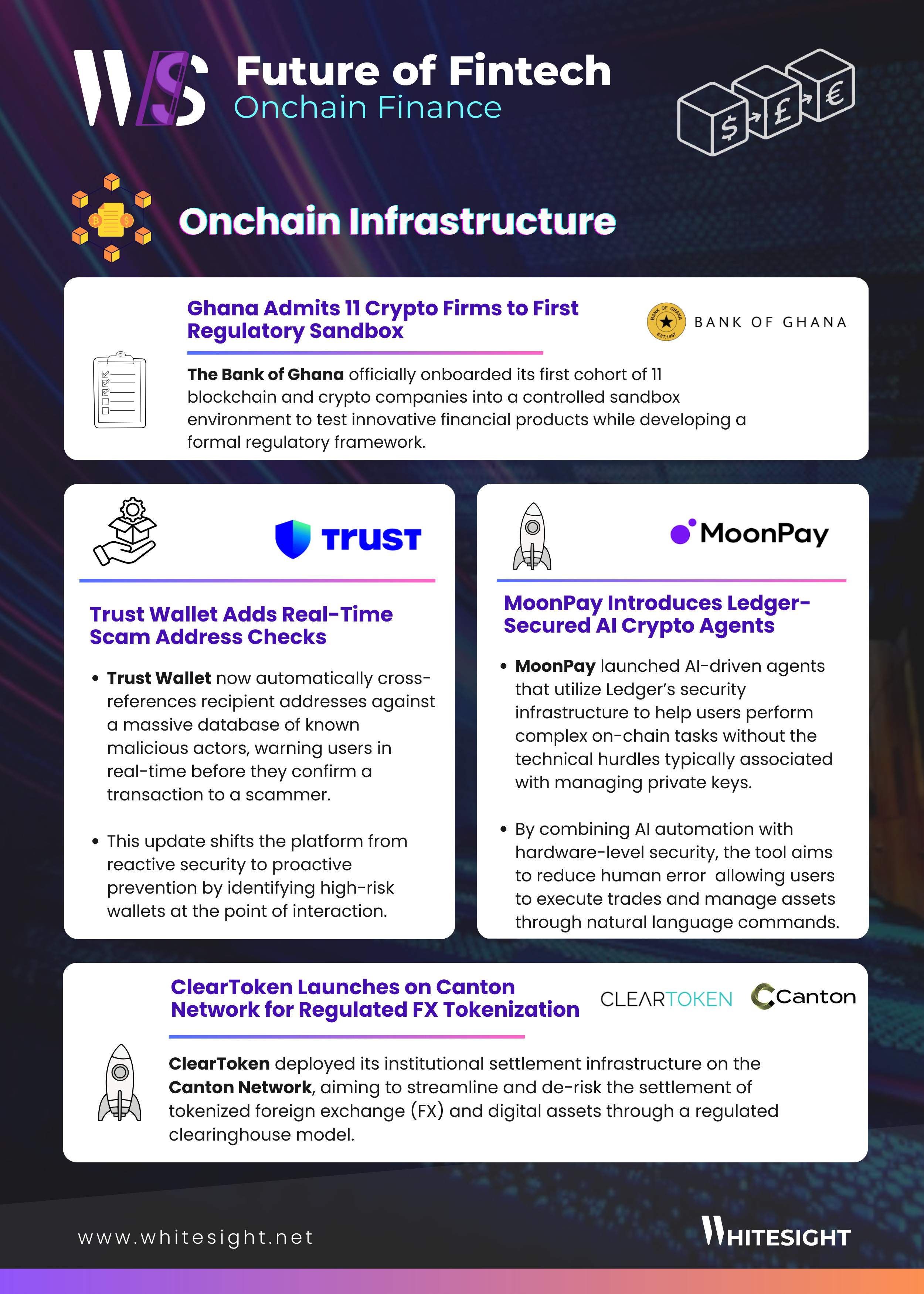
The News: BitGo was named the primary custodian for StableX Technologies’ planned M-stablecoin crypto treasury.
Implication: As corporate treasuries move onchain, the role of a ‘crypto vault’ becomes as critical as a central bank, with BitGo setting the gold standard for institutional safety.
The News: Shift Markets partnered with Guardrail to integrate advanced security infrastructure across its global exchange network.
Implication: With exchange hacks becoming more sophisticated, “infra-level” security partnerships are becoming a mandatory requirement for any platform handling user funds.
Onchain Yield
The battle for yield is moving into automated DeFi vaults and regulated staking vehicles.
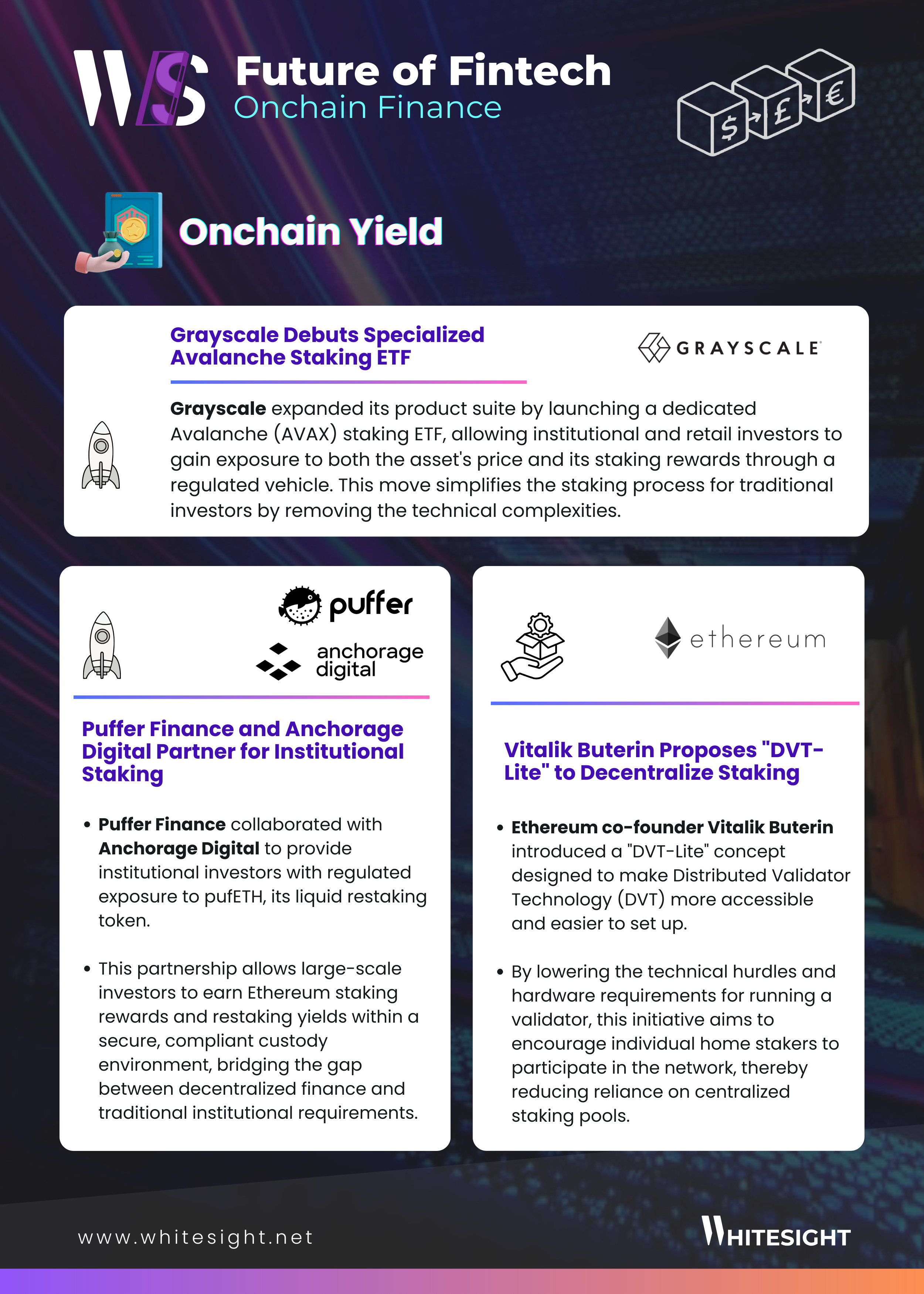
The News: Lido launched “earnUSD” stablecoin vaults, allowing users to automatically capture optimized yields across the DeFi ecosystem.
Implication: Liquid staking is expanding beyond ETH; Lido is now positioning itself as the ‘yield layer’ for the entire stablecoin economy.
The News: Grayscale launched a dedicated Avalanche (AVAX) staking ETF to provide investors with a regulated path to staking rewards.
Implication: The “ETF 2.0” era has arrived, where the value proposition is not limited to holding an asset, but capturing the network-native yield that comes with it.
Onchain Lending
Cross-chain protocols and liquidity glitches are testing the resilience of decentralized credit markets.
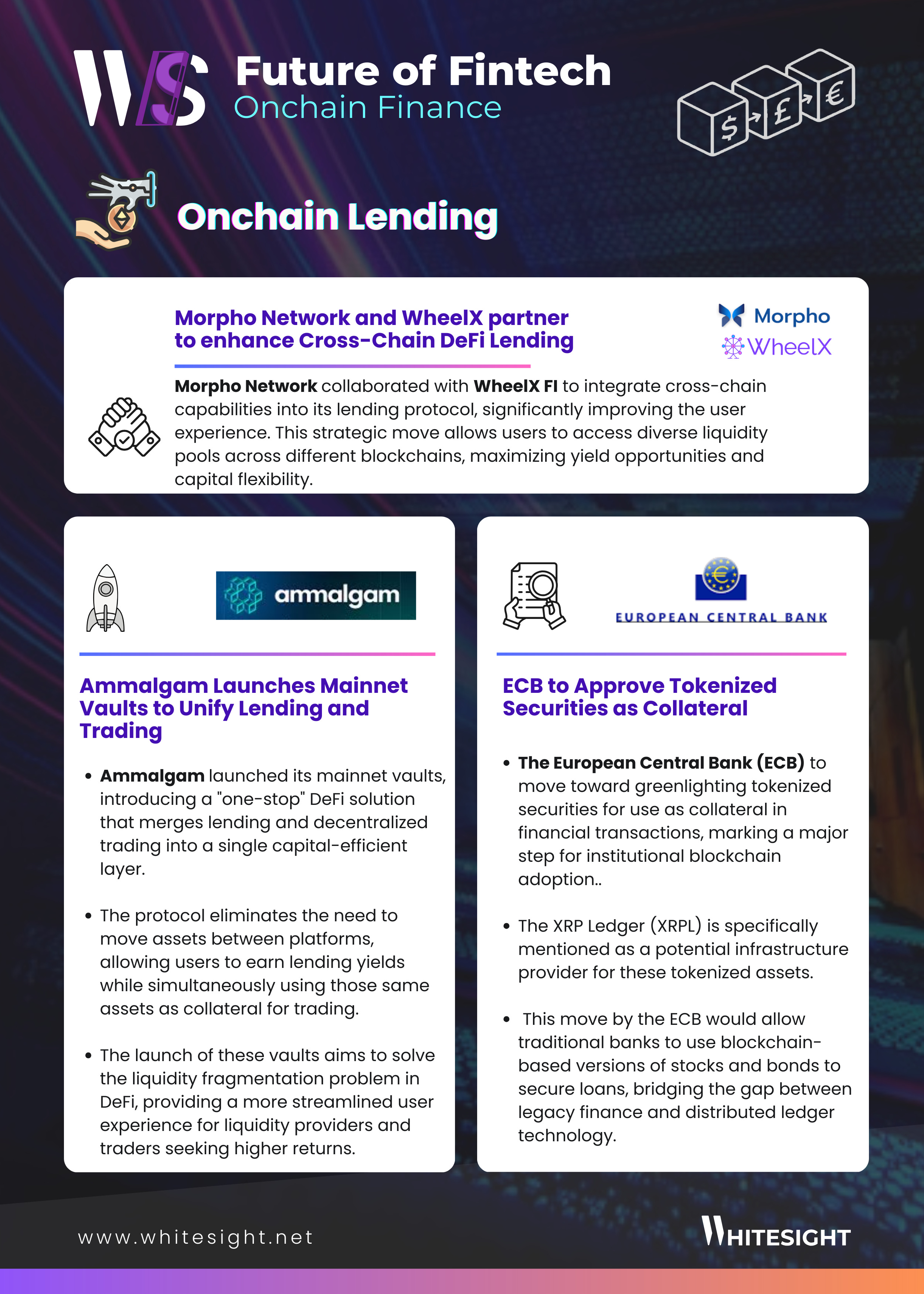
The News: Morpho Network collaborated with WheelX FI to bring cross-chain applications to its DeFi lending protocol, enhancing liquidity access.
Implication: The future of lending is ‘chain-agnostic’; users will soon borrow and lend assets across multiple networks without ever realizing they are moving between blockchains.
The News: Aave experienced $27 million in liquidations following a rare price-feed glitch that triggered automated health-factor shutdowns. '
Implication: While DeFi is efficient, this event serves as a reminder that ‘oracle risk’ remains the Achilles’ heel of automated lending, requiring even more robust fail-safes as the sector scales.
And that’s a wrap 👋
We hope you enjoyed this edition of the Onchain Finance!
If you’re someone who likes to read think pieces, you will likely love our monthly blog, Fintersections, where our team members analyse the convergence of fintech with the world.
And lastly, to stay updated on everything fintech and web3, follow us on LinkedIn and Twitter, and don’t be shy to show some ❤️
Thanks for reading Future of FinTech Newsletter! Subscribe for free to receive new posts and support my work.