
February saw AI agents deployed across both back-office finance and consumer-facing transactions.
Across payments, crypto, banking, infrastructure, and AI platforms, agents moved beyond pilots and into live financial environments. Use cases involved initiating transactions, processing invoices, assisting customers, automating compliance, and operating inside secure government systems.
✔ Card networks and fintech processors formalized authenticated agent-led payments.
✔ Crypto infrastructure providers enabled AI-native wallets and autonomous blockchain execution.
✔ Banks and insurers embedded agents directly into onboarding, servicing, and operational workflows.
Ready for the agentic signals that defined the first two weeks of February? 🔍⚡
🚨 Featured Story of the Week:
Razorpay and NPCI Bring Agentic Payments to Everyday Commerce
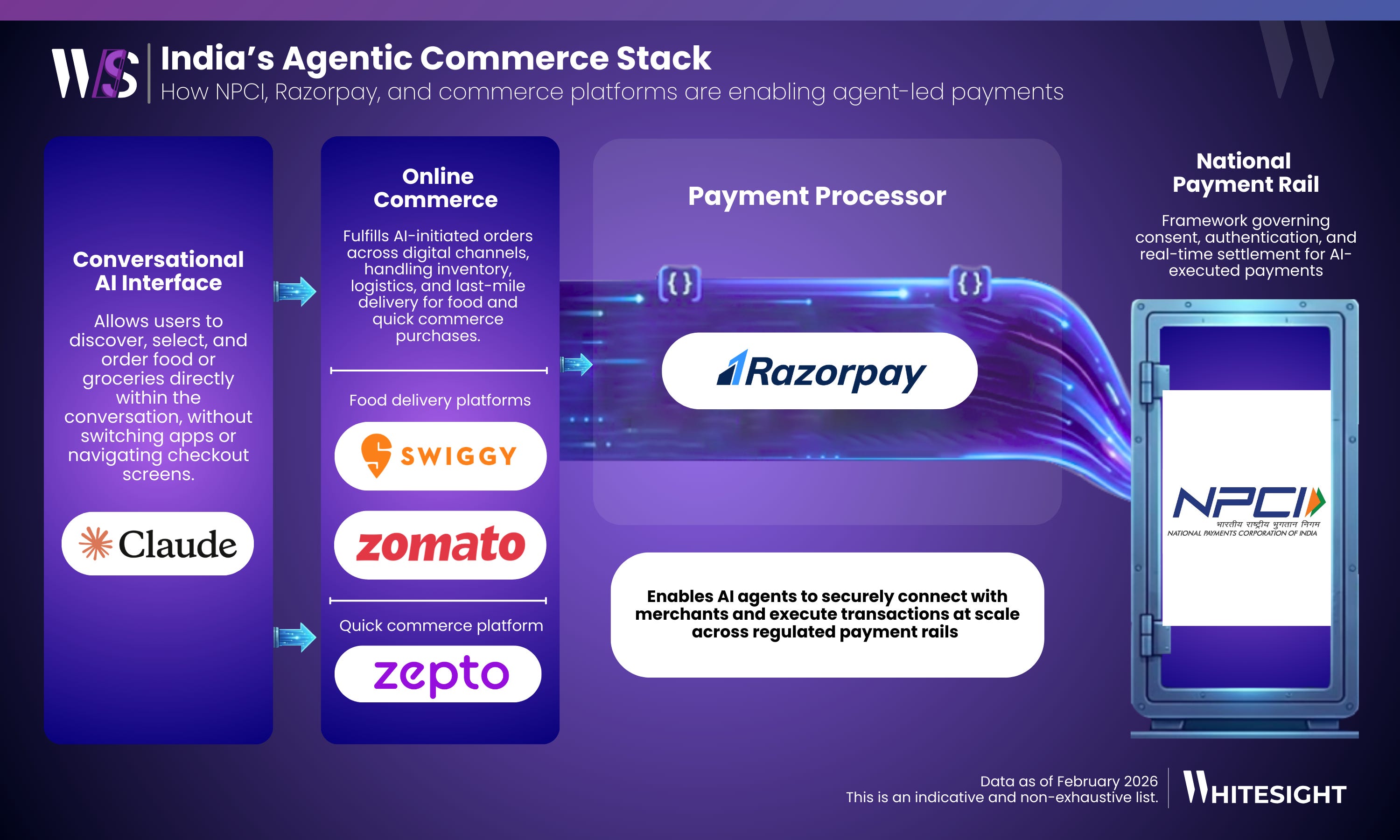
Razorpay and the National Payments Corporation of India (NPCI) have launched an agentic payments pilot on Anthropic’s Claude. This enables conversational AI to complete UPI transactions, from food delivery in Swiggy and Zomato to quick commerce in Zepto. This capability integrates Razorpay’s payment stack, NPCI’s UPI rails, and Claude’s natural language understanding to interpret intent, present options, and execute payments within a single conversation.
Why it matters
Agentic Payments bridges discovery and purchase, transforming AI assistants from suggestion engines into transaction executors. By operating on India’s widely adopted UPI infrastructure, the pilot anchors autonomous payments to familiar, trustworthy rails.
What does it signal?
Conversational commerce inches toward reality: Users can shop and pay via AI without intermediary checkout screens, flattening the journey from intent to settlement.
UPI as an agentic backbone: NPCI’s mandate-driven model provides the secure, consent-based plumbing necessary for autonomous AI execution.
Behavior-driven payments scale: Early integrations with platforms like Zomato, Swiggy, and Zepto show that high-frequency use cases are fertile ground for AI-native purchase flows.
If agentic payments are to move beyond novelty, embedding them into ubiquitous, regulated payment rails could become the proving ground for scalable, secure autonomous commerce.
If agentic AI needs mass-scale validation, India’s UPI ecosystem may be it.
Thanks for reading Future of FinTech - Agentic AI Newsletter! Subscribe for free to receive new posts and support our work.
Thanks for reading Future of FinTech Newsletter! Subscribe for free to receive new posts and support our work.
🚀 Startup Spotlight: Jump
This edition, we’re spotlighting Jump, an AI-native assistant and intelligence engine purpose-built for financial advisors and wealth management professionals. Fresh off an $80 million Series B, Jump is scaling what it calls an AI operating system for advisory firms. It is embedding automation directly into the daily workflows of client-facing financial professionals.

Jump plugs directly into advisory tech stacks, turning meetings, emails, and documents into structured intelligence. Advisors get automated summaries, compliance-ready documentation, and task generation in real time.
Got something cool brewing in agentic finance? We’d love to feature you next- drop us a note at hello@whitesight.net 👋
Pledge your access to fintech analysis and exclusive insights ⚡
What’s on the fintech menu today?
🏁 Agentic Highlights: Biggest moves across agentic payments, agentic banking, and agentic commerce
🧩 ‘Byte’ Buzz: Agentic Finance updates, sorted by segment
🔗 Link Up: A curated set of reads worth your time
Sip on bite-sized agentic updates - fresh, sharp, and distilled to keep you ahead in just minutes. Subscribe now! 📨
📢 We’re always seeking innovative voices in fintech to be our next guest feature!
With a community of 2100+ fintech enthusiasts, we’d love to amplify your insights. Reach out to us for features, sponsorships, or collaborations!
Get Unlimited Access to Strategy Playbooks of Fintech Pioneers with WhiteSight Radar! 🚀

Unlock a treasure trove of fintech intel with a WhiteSight Radar subscription. See further with exclusive reports, industry trend breakdowns, and expert analysis on everything from Embedded Finance and Digital Banking to Open Finance and beyond.
Become a member and steer your business course with actionable intelligence on the winning strategies of leading companies like Apple, Stripe, Starling Bank, OakNorth Bank, Banco Inter, and Toast that propels your business to the forefront of fintech. (PLUS! More in our premium content pipeline - Amazon, Nubank, Grab, Wise, Shopify, Affirm, Mercado Libre… the list goes on!)
Supercharge your Fintech IQ with WhiteSight Radar, putting expert fintech intel at your fingertips! 🧭
Edition 3 brings you the agentic finance stories that shaped how agents shaped the finance and fintech industry in the first two weeks of February
February’s Top Agentic Tea!♨️
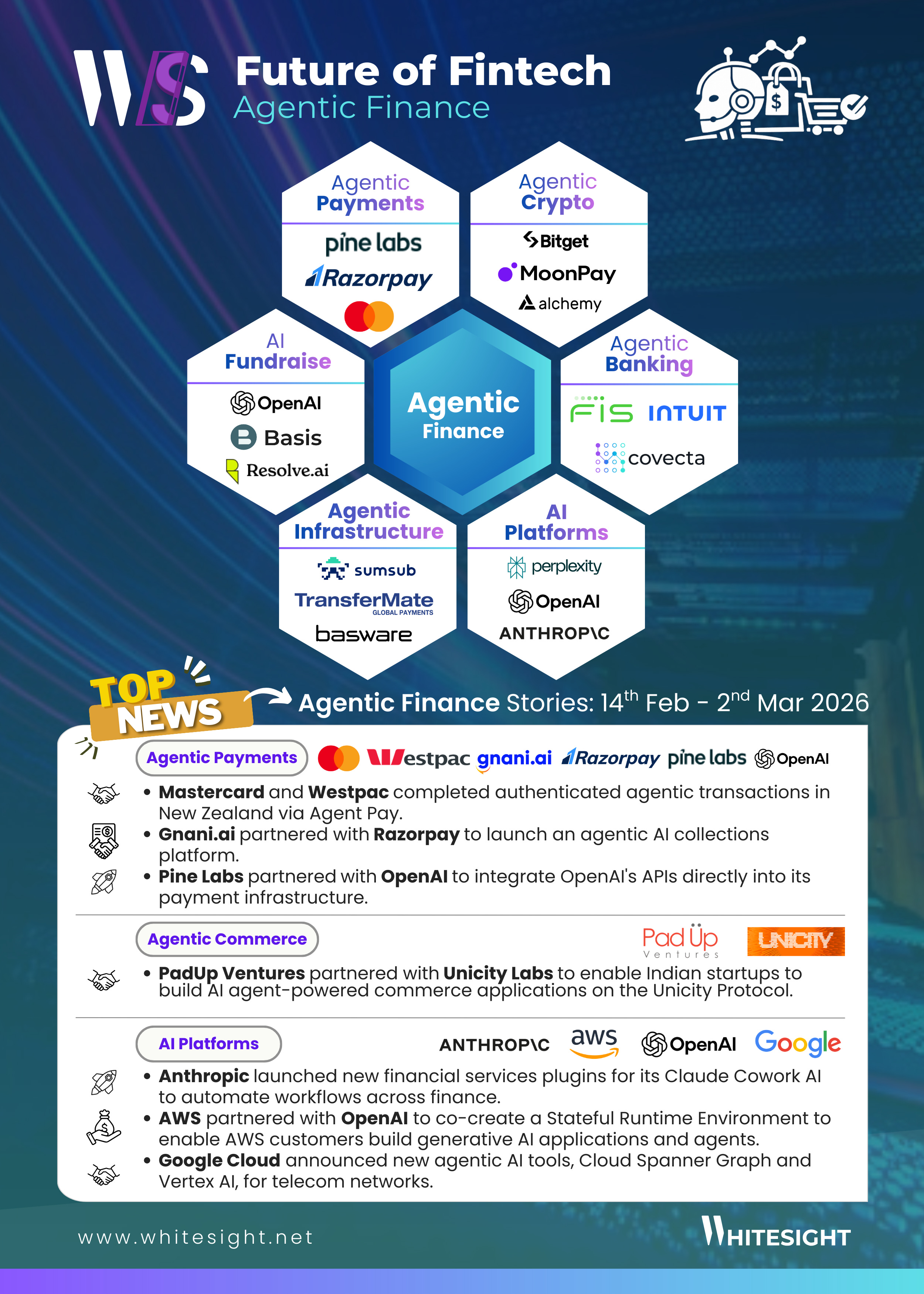
Agentic Payments
⤷ Mastercard and Westpac successfully executed New Zealand’s first AI-enabled transactions using Mastercard’s Agent Pay framework.
⤷ Gnani.ai joined forces with Razorpay to introduce an AI-driven debt recovery solution powered by agentic technology.⤷ Pine Labs entered into a collaboration with OpenAI to embed OpenAI’s APIs within its core payments ecosystem.
Agentic Commerce
⤷ PadUp Ventures teamed up with Unicity Labs to support Indian startups in developing AI-agent-based commerce solutions.
AI Platform Updates
⤷ Anthropic rolled out specialized finance-focused plugins for Claude Cowork, aimed at streamlining operational processes within financial institutions.
⤷ AWS and OpenAI partnered to build a Stateful Runtime Environment, helping AWS clients develop and deploy generative AI applications and intelligent agents.⤷ Google Cloud unveiled new agentic AI capabilities alongside updates to Cloud Spanner Graph and Vertex AI, targeting telecom industry applications.
Now, for the ‘byte’-sized fintech buzz –
Agentic payments continued to mature as real-world deployments demonstrated AI systems executing financial transactions with minimal human involvement.
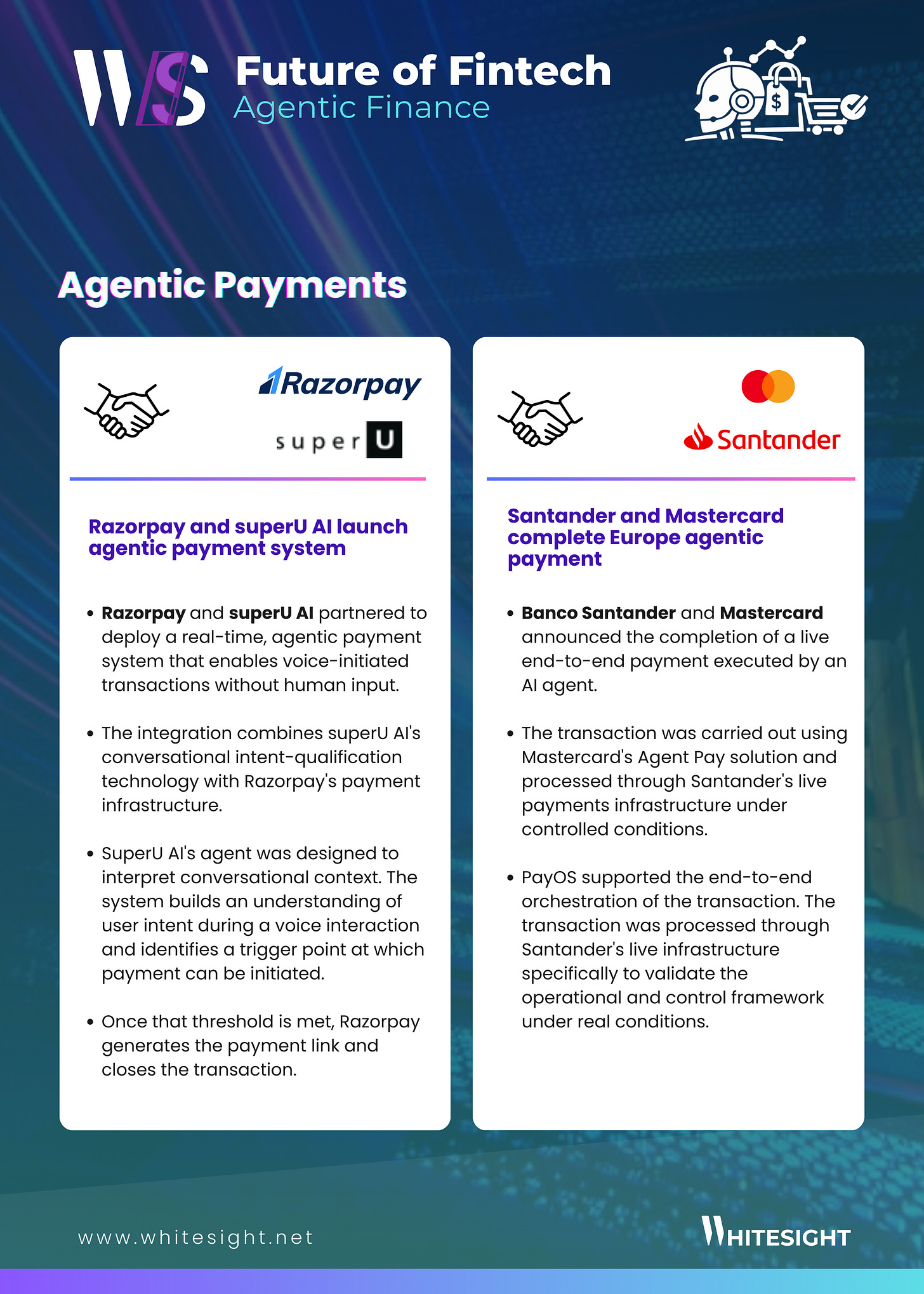
Razorpay and superU AI launch conversational AI payment system
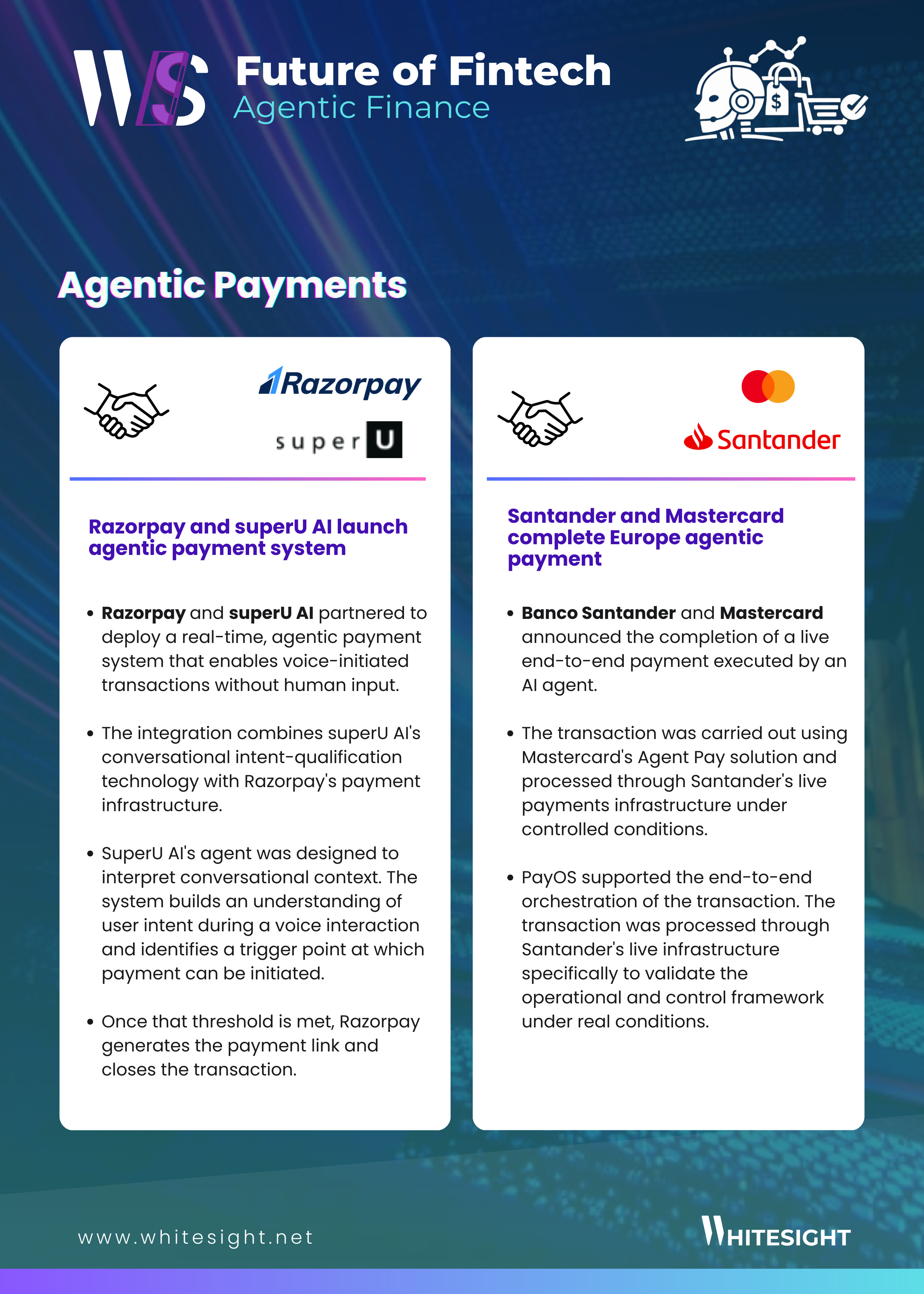
Razorpay teamed up with superU AI to unveil a live agentic payment solution that lets users initiate and complete transactions using natural voice or chat interactions.
Industry implications: By enabling voice- and chat-based payments that close the loop instantly, this collaboration underscores a shift toward payments that are implicitly triggered by contextual understanding.
Mastercard and Westpac complete agentic transactions in NZ
Mastercard, in collaboration with Westpac, completed agentic transactions in New Zealand using its Agent Pay framework, processing purchases such as cinema tickets and hotel bookings.
Industry implications: Card networks and banks are formalising frameworks for AI-initiated transactions, embedding standards and authentication into the rails.
Agentic crypto infrastructure progressed as protocols enabled AI systems to autonomously execute blockchain interactions.
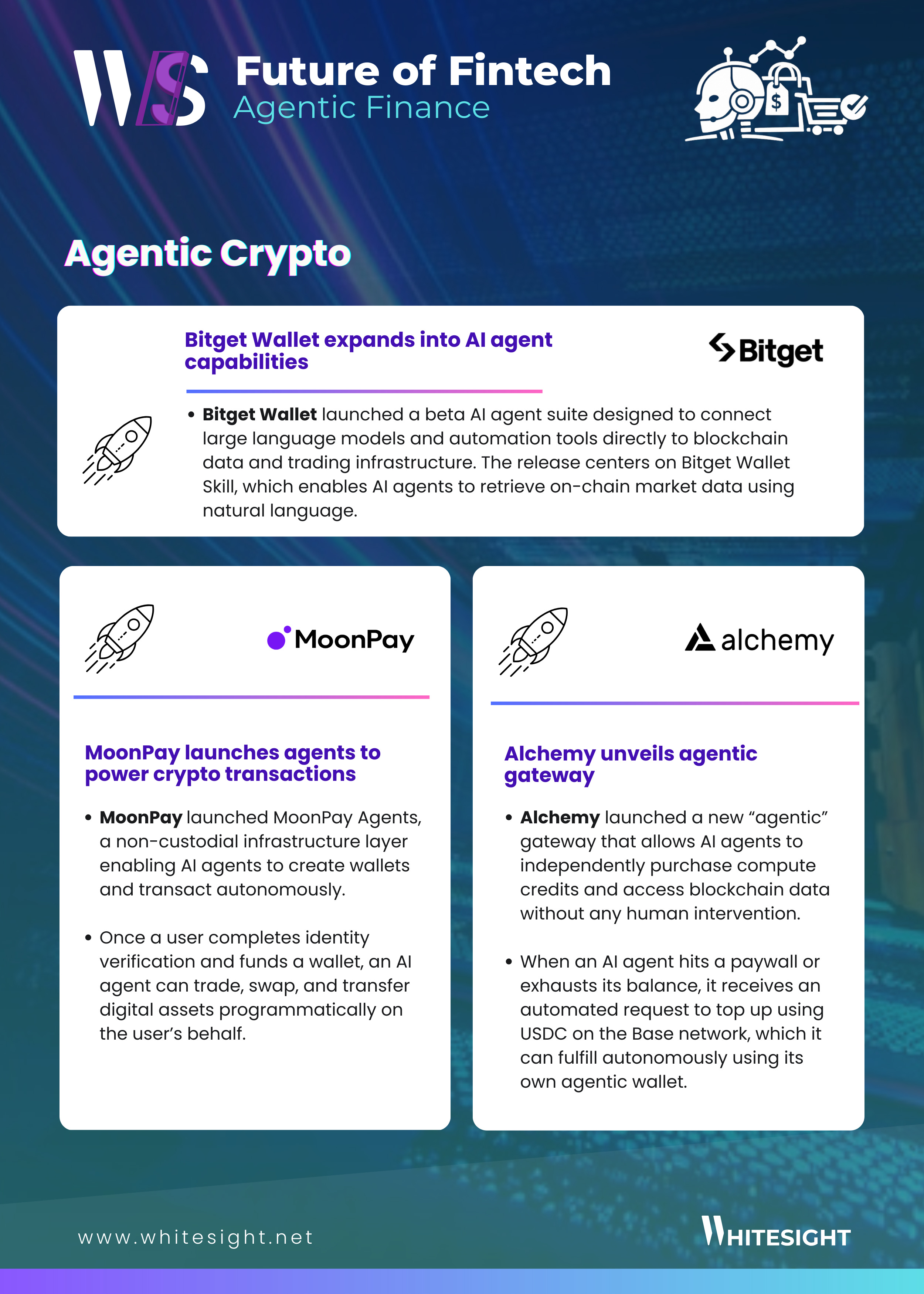
MoonPay launches MoonPay Agents for AI-driven crypto transactions
MoonPay introduced MoonPay Agents to let AI systems autonomously initiate, approve, and complete crypto transactions on users’ behalf.
Industry implications: MoonPay’s agentic layer signals a shift toward intelligent transaction execution, reducing manual wallet interactions and enabling more seamless AI-orchestrated crypto flows.
Alchemy unveils autonomous infrastructure access for AI agents
Alchemy released support for the X402 standard, allowing AI agents to interact autonomously with blockchain infrastructure for execution and data retrieval.
Industry implications: Standardised agentic infrastructure access points towards broader developer adoption and unified agent behaviour across protocols, accelerating autonomous blockchain usage.
Agentic banking capabilities expanded as institutions leveraged AI agents to automate customer engagement and core operations.
CoverGo deploys AI agents to automate insurance workflows
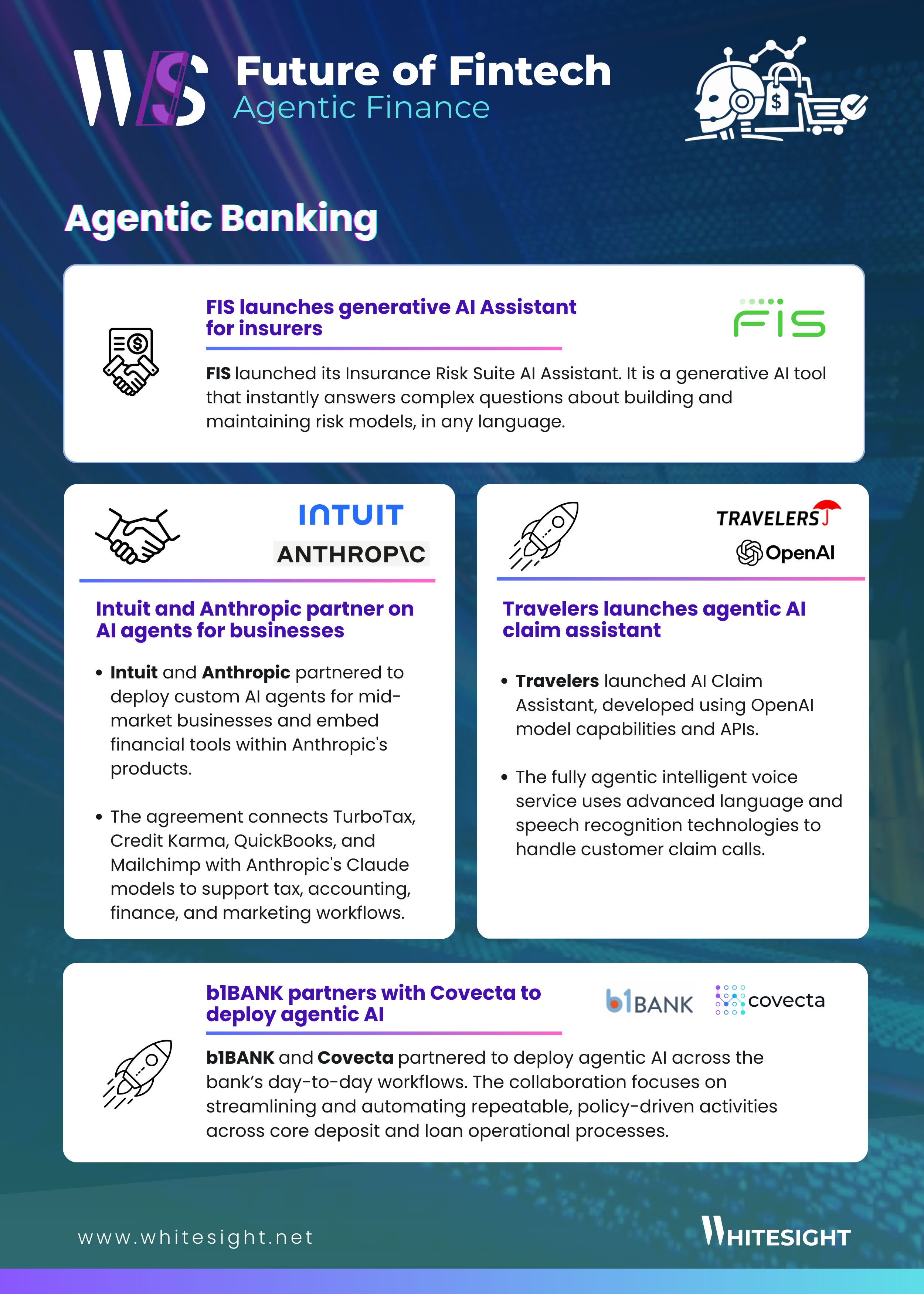
CoverGo introduced autonomous AI agents to streamline policy processing, claims handling, and risk assessments across insurance operations.
Industry implications: This deployment signals insurers’ move toward AI-driven operational automation, reducing manual processing and accelerating service delivery.
CaixaBank launches AI agent to assist customers
CaixaBank rolled out its first AI agent to help customers select and buy banking products directly within its mobile app.
Industry implications: CaixaBank’s in-app agent reinforces personalized digital engagement and points to broader adoption of conversational AI in retail banking.
AI platform innovation continued as foundational model providers expanded tooling, enabling autonomous task execution and defense partnerships.
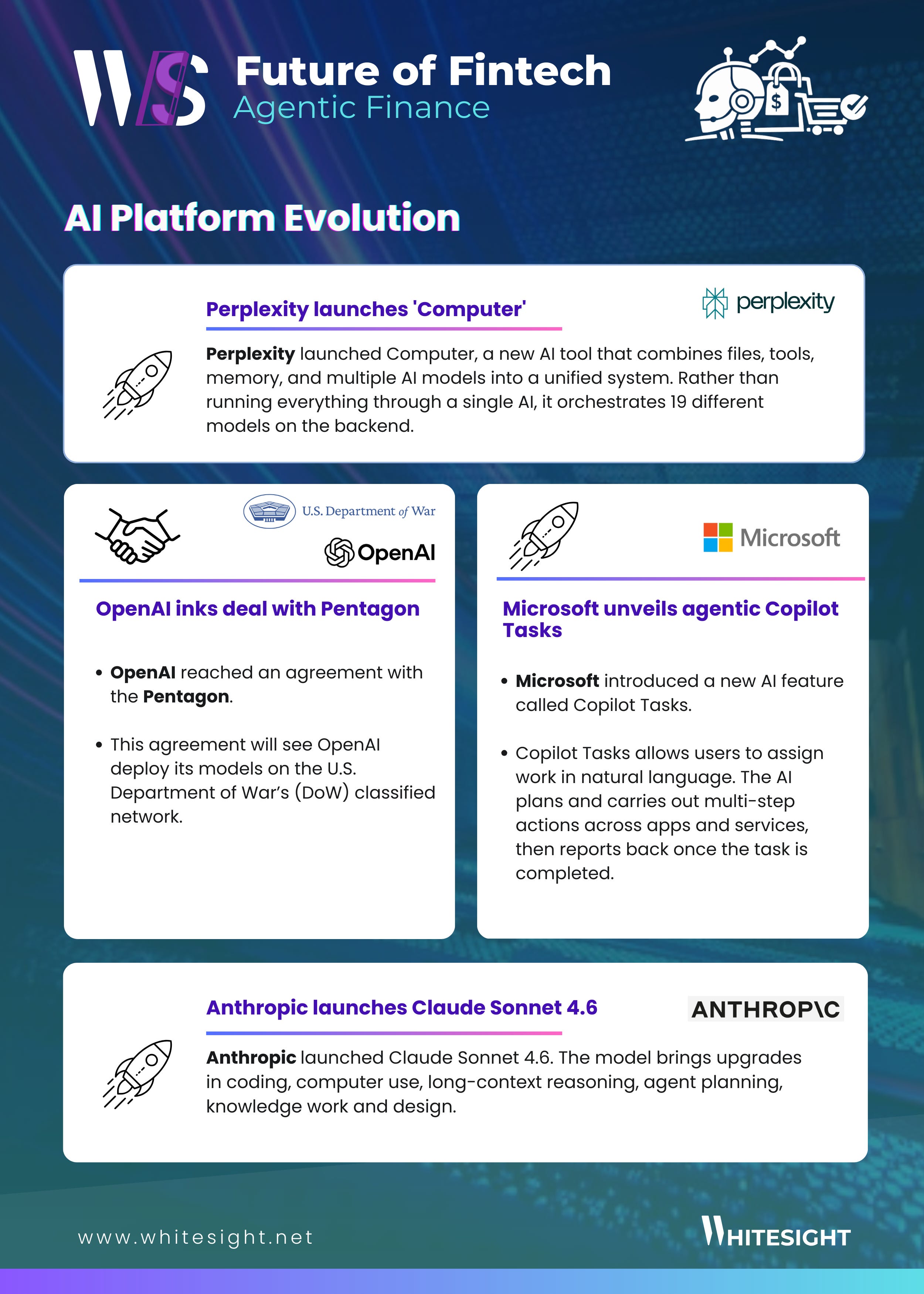
OpenAI agrees Pentagon deal amid Anthropic dispute
OpenAI secured a Pentagon agreement to supply advanced AI capabilities for defense applications amid tensions with Anthropic.
Industry implications: This agreement underscores increasing government reliance on commercial AI platforms for mission-critical workloads and competitive positioning among model providers.
Microsoft reveals agentic Copilot Tasks for background execution
Microsoft introduced Copilot Tasks, enabling its AI assistant to autonomously execute multi-step tasks behind the scenes.
Industry implications: Background task automation pushes AI beyond interactive assistance toward autonomous workflow orchestration across productivity ecosystems.
Agentic infrastructure advanced as enterprise platforms rolled out autonomous agents to handle critical backend workflows and compliance operations.
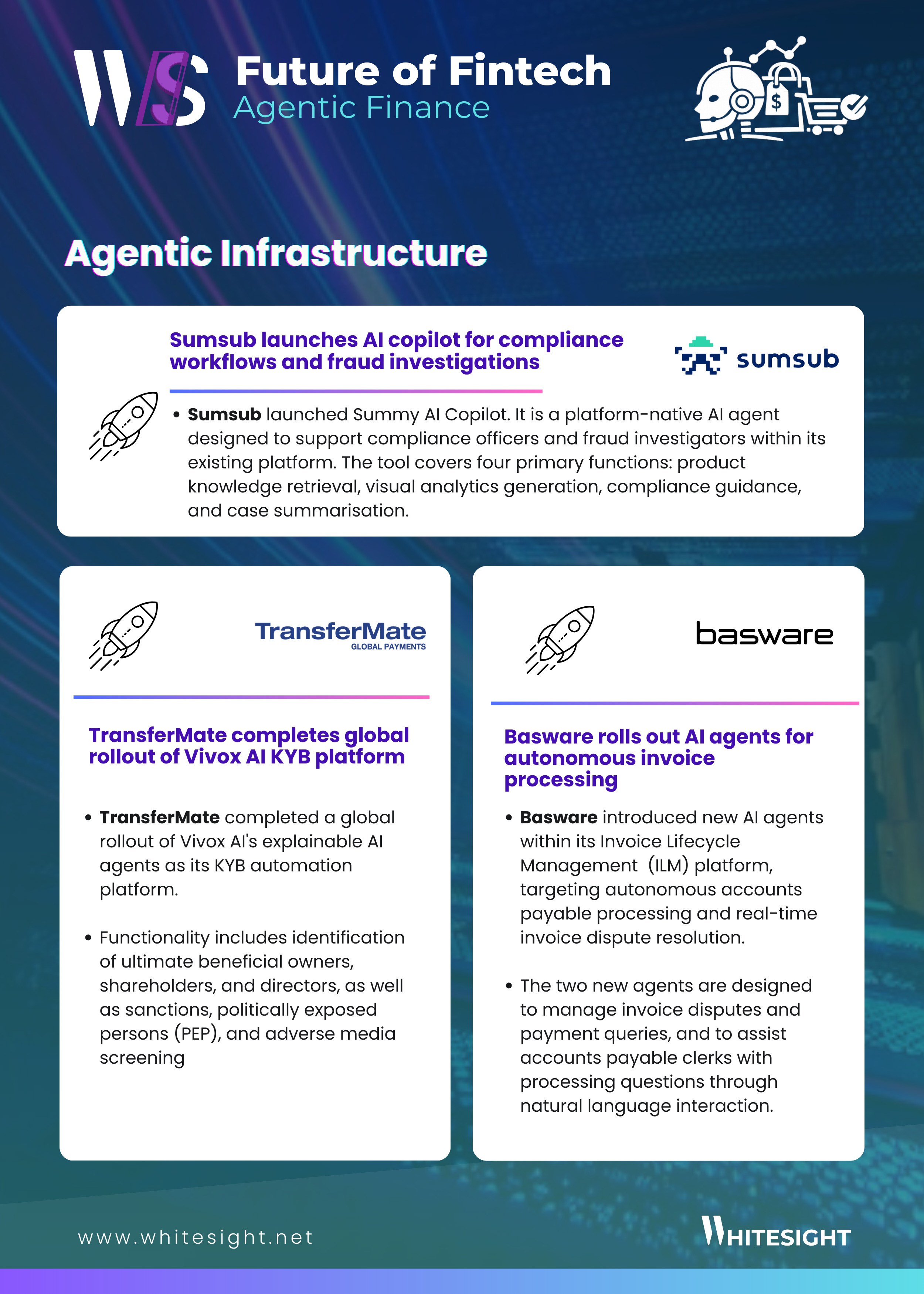
Basware launches AI agents for autonomous invoice processing
Basware introduced AI agents that autonomously manage invoice intake, classification, and processing across enterprise finance systems.
Industry implications: Autonomous invoice agents signal a shift toward hands-off accounts payable automation, reducing manual bottlenecks and accelerating finance operations.
Sumsub launches AI Copilot for compliance and fraud workflows
Sumsub unveiled an AI Copilot to automate compliance checks and assist in fraud investigations across identity verification pipelines.
Industry implications: Embedding agentic tooling into compliance frameworks highlights real-time risk detection and reduced analyst workload in fraud and regulatory controls.
Funding continued to flow in agentic finance as generative AI infrastructure and autonomous computing ventures secured major investment rounds.
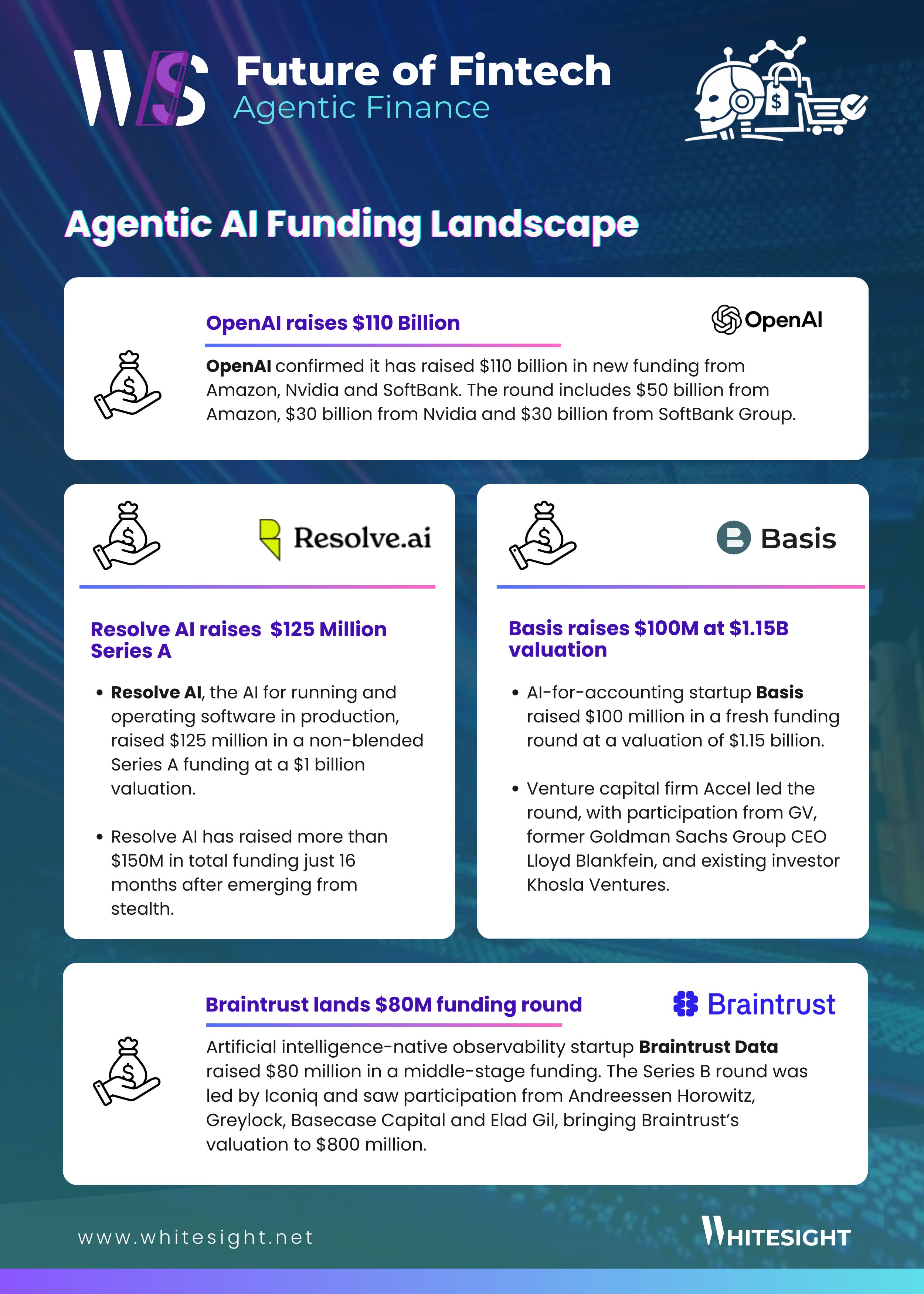
OpenAI raises $110 billion to build global AI infrastructure
OpenAI secured a massive $110 billion funding commitment aimed at expanding global AI infrastructure and model development capabilities.
Industry implications: This unprecedented capital infusion underscores confidence in foundational AI as critical infrastructure and accelerates the competitive buildup of agentic platforms worldwide.
ChipAgents secures $50 million to accelerate agentic chip design
ChipAgents closed a $50 million financing round to advance bespoke hardware tailored for autonomous AI agent workloads.
Industry implications: Targeted funding for agentic-optimized silicon highlights investor belief that specialized hardware will underpin next-generation autonomous compute ecosystems.
Anthropic vs. the US Department of War
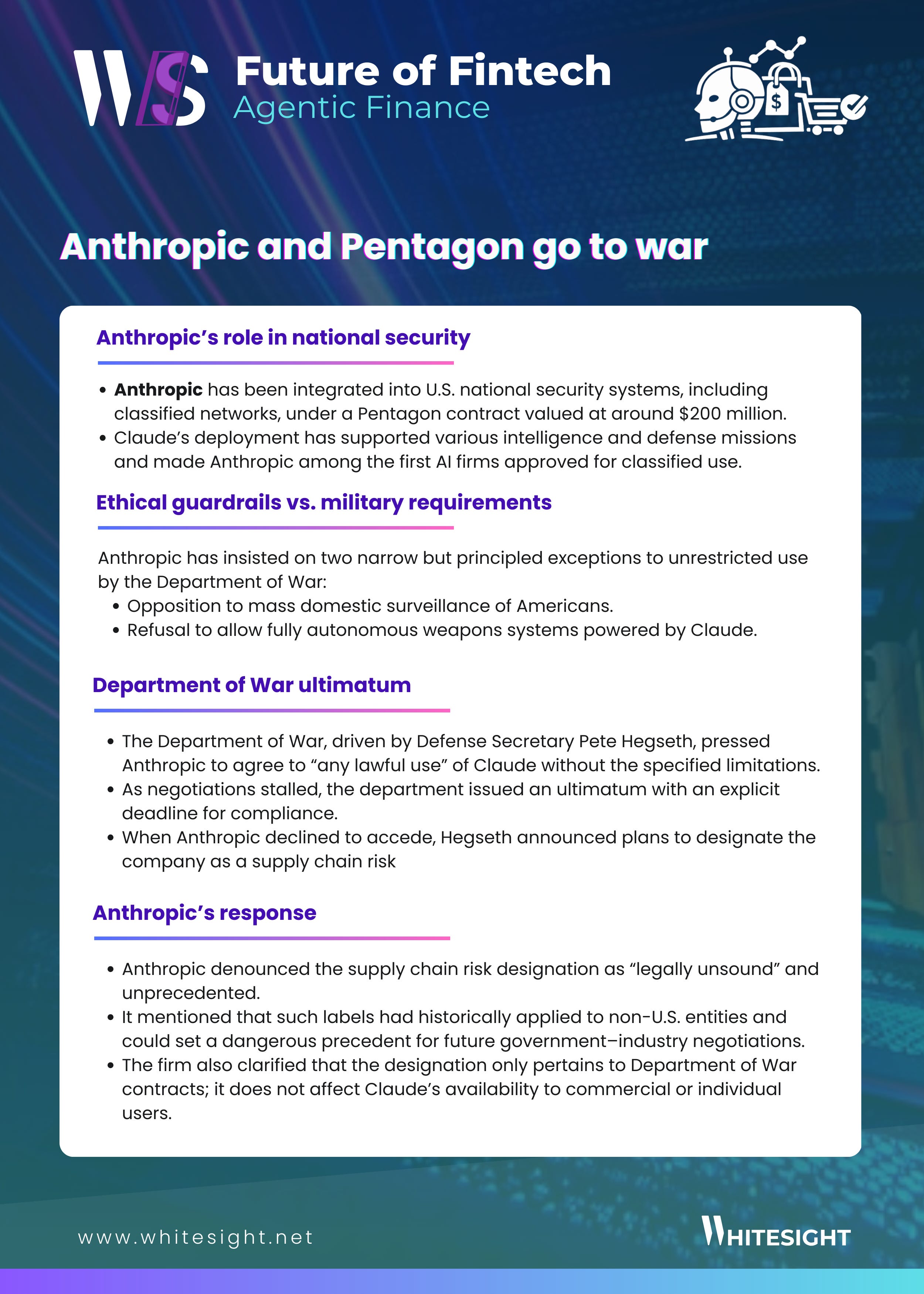
Anthropic’s Claude models have been integrated into sensitive U.S. national security environments under a major defense contract, positioning the company as a strategic AI supplier rather than a purely commercial vendor. The dispute emerged over deployment boundaries. While Anthropic supported lawful defense applications, it sought explicit restrictions on large-scale domestic surveillance and fully autonomous weapons. The Department of War reportedly pushed for unrestricted use of the models across all lawful military contexts, framing vendor-imposed limits as operational constraints. Tensions escalated when the Department threatened to classify Anthropic as a supply chain risk, shifting the conflict from contractual negotiation to regulatory pressure. Such a designation could affect procurement eligibility and signal institutional disapproval. Anthropic rejected the move, arguing it lacked precedent and emphasizing that its stance reflects risk management, not disengagement from national security work. The company also clarified that any designation would not affect commercial customers.
And that’s a wrap 👋
We hope you enjoyed this edition of the Agentic Finance Brew!
As a reward for making it this far, here’s a curated set of agentic resources to keep your curiosity (and conviction) topped up. Cheers to continuous learning!
Link Up! –
Supply Chain Financing: Durable Global Trade in the Age of AI - CITI
Agentic AI untangled: Navigating the build, buy, or borrow decision - KPMG
The automation curve in agentic commerce - McKinsey
How Agentic AI Can Power Core Insurance IT Modernization - BCG
If you’re someone who likes to read think pieces, you will likely love our monthly blog, Fintersections, where our team members analyse the convergence of fintech with the world.
And lastly, to stay updated on everything fintech and web3, follow us on LinkedIn and Twitter, and don’t be shy to show some ❤️
Thanks for reading Future of FinTech Newsletter! Subscribe for free to receive new posts and support my work.