
The past weeks marked a clear transition from isolated agent experiments to coordinated infrastructure buildout across finance.
Across payments, crypto, banking, infrastructure, and AI platforms, agents moved beyond pilots and into live financial environments. Use cases spanned agent-led payments, automated lending workflows, AI-driven trading, and real-time compliance across financial systems.
✔ Card networks and fintech processors formalized authenticated agent-led payments.
✔ Crypto infrastructure providers enabled AI-native wallets and autonomous blockchain execution.
✔ Lenders are integrating agents into underwriting, servicing, and bureau-driven decisioning to accelerate credit workflows.
Ready for the agentic signals that defined the first two weeks of March? 🔍⚡
🚨 Featured Story of the Week:
Mastercard Expands Agentic Commerce Across APAC
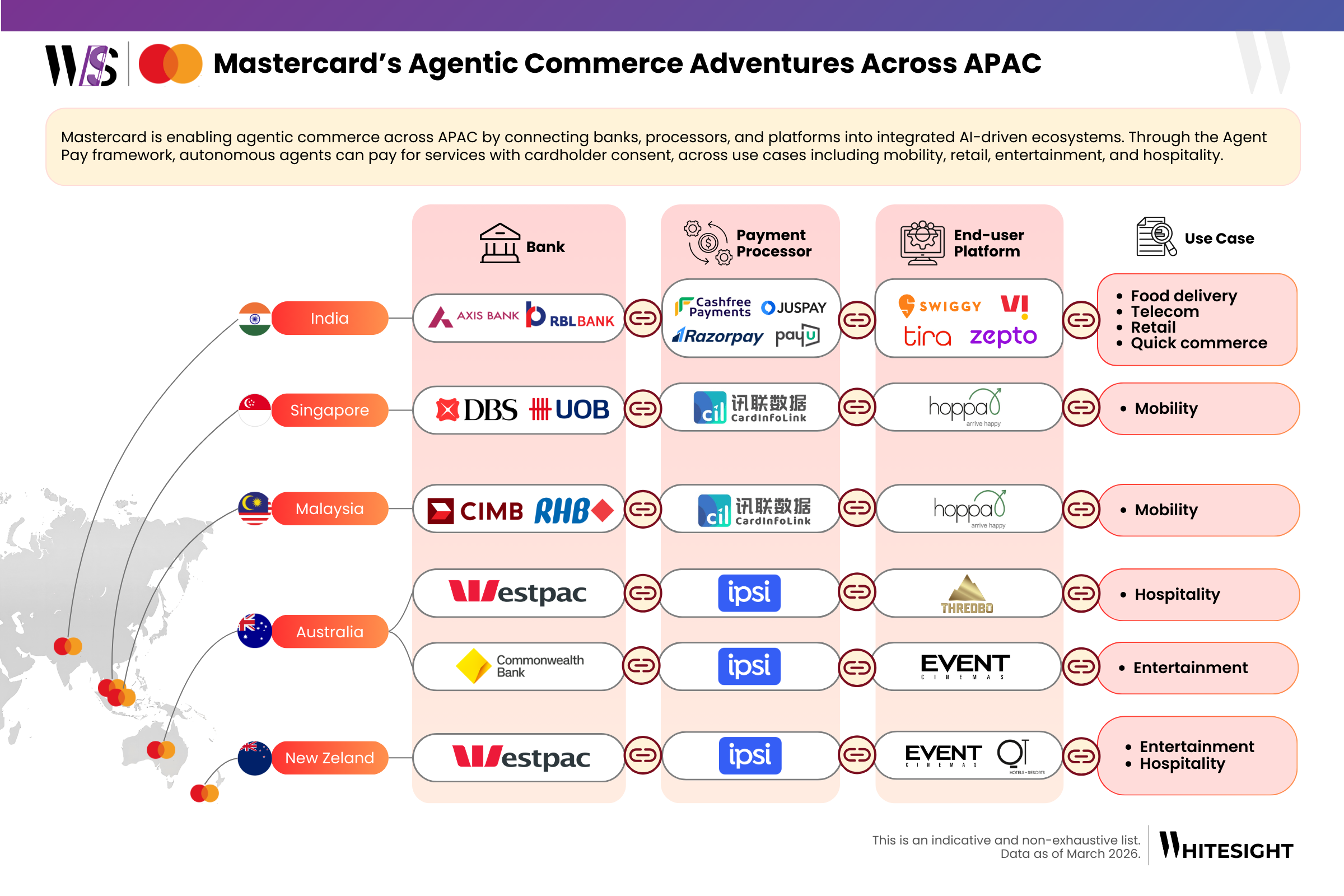
Mastercard is rapidly scaling agentic commerce across the Asia Pacific, moving from pilots to live, authenticated AI-driven transactions across multiple markets. In Singapore, it completed its first live agentic transaction with DBS and UOB, where an AI agent successfully booked a ride using its Agent Pay framework.
This builds on parallel deployments across Malaysia, Australia, New Zealand, and India, where Mastercard is working with banks, processors, and platforms to embed AI agents directly into payment flows. In Malaysia, pilots with CIMB, Maybank, and RHB demonstrated secure, consent-driven transactions using tokenization and passkey-based authentication.
Why it matters
APAC is a calculated beachhead for Mastercard. The region’s e-commerce market is projected to exceed $7 trillion by 2030, the world’s largest. 74% of APAC consumers already use AI-powered tools for product discovery. India leads global GenAI adoption at 73%. In Australia alone, agentic commerce could influence 55% of all consumer transactions by 2030, worth A$670 billion. The infrastructure preconditions, tokenization, contactless penetration, and super-apps are already built.
Competitive urgency accelerates the timeline. DBS piloted agentic payments with Visa in February and Mastercard in March; same bank, rival networks, weeks apart. Both are racing to embed their trust standard in the highest-AI-adoption commerce region on earth. The standard that wins here sets the default everywhere else.
Breaking down the regional strategy:
The Mobility & Travel Hub (Singapore & Malaysia): Mastercard completed its agentic transactions in Singapore (with DBS and UOB) and Malaysia (CIMB and RHB), targeting the mobility sector. Using the Hoppa platform and CardInfoLink as the processor, agents can now autonomously book and pay for transport, proving that cross-border frameworks can maintain regional compliance.
The High-Frequency Retail Engine (India): In India, the strategy focuses on retail and quick commerce. It partnered with Axis Bank and RBL Bank, and integrated with dominant platforms like Swiggy, Zepto, and Zomato. Mastercard is testing the high-concurrency limits of agentic payments in one of the world’s most digitized payment markets.
The Lifestyle & Leisure Integration (Australia & New Zealand): Down Under, the focus shifts to hospitality and entertainment. Working with Westpac and Commonwealth Bank, Mastercard has embedded agentic flows into Thredbo (hospitality) and Event Cinemas. This signals a move to capture discretionary spend through AI assistants that manage a user’s social and travel calendar.
What does it signal?
Tokenization as the agent’s ID: Mastercard assigns each AI agent a unique Agentic Token. Raw card numbers never touch the agent layer. The agent itself becomes the authenticated bearer of the credential. This collapses the fraud surface area of autonomous commerce by design.
Consent-as-a-Service: Agent Pay introduces a new identity management layer between the consumer and the transaction. Banks like DBS and Westpac are evolving from money custodians to consent managers. Their role: verify that a specific AI agent has permission to spend a specific amount. This rewires the bank’s position in the agentic value chain entirely.
If the future of commerce is an AI placing orders on your behalf, someone still has to guarantee that the transaction is authentic. Mastercard just pitched in, with a unique token for every agent and a passkey for every purchase.
Curious about how payment processors are architecting for the agentic era? Our Adyen deep dive maps the full stack.
Thanks for reading Future of FinTech - Agentic AI Newsletter! Subscribe for free to receive new posts and support our work.
Thanks for reading Future of FinTech Newsletter! Subscribe for free to receive new posts and support our work.
🚀 Startup Spotlight: Cognition AI
This edition, we’re spotlighting Cognition AI, a San Francisco-based applied AI lab that built Devin, the first autonomous AI software engineer. It’s an agent that plans, codes, tests, debugs, and deploys software end-to-end in a sandboxed environment.
Cognition bets that AI agents capable of long-horizon reasoning and tool use can automate entire engineering workflows.

Devin’s ARR grew from $1 million in September 2024 to $73 million by June 2025. Cognition then closed a $400 million round at a $10.2 billion valuation, with total funding now standing at $896 million. In July 2025, Cognition acquired Windsurf, an AI coding integrated development environment (IDE). Combined enterprise ARR jumped over 30% in just seven weeks post-acquisition. Total net burn has stayed under $20 million since founding.
Enterprise customers include Goldman Sachs, Citi, Dell, Cisco, Palantir, Nubank, and Mercado Libre.
Got something cool brewing in agentic finance? We’d love to feature you next- drop us a note at hello@whitesight.net 👋
Pledge your access to fintech analysis and exclusive insights ⚡
What’s on the fintech menu today?
🏁 Agentic Highlights: Biggest moves across agentic payments, agentic banking, and agentic commerce
🧩 ‘Byte’ Buzz: Agentic Finance updates, sorted by segment
🔗 Link Up: A curated set of reads worth your time
Sip on bite-sized agentic updates - fresh, sharp, and distilled to keep you ahead in just minutes. Subscribe now! 📨
📢 We’re always seeking innovative voices in fintech to be our next guest feature!
With a community of 2100+ fintech enthusiasts, we’d love to amplify your insights. Reach out to us for features, sponsorships, or collaborations!
Get Unlimited Access to Strategy Playbooks of Fintech Pioneers with WhiteSight Radar! 🚀

Unlock a treasure trove of fintech intel with a WhiteSight Radar subscription. See further with exclusive reports, industry trend breakdowns, and expert analysis on everything from Embedded Finance and Digital Banking to Open Finance and beyond.
Become a member and steer your business course with actionable intelligence on the winning strategies of leading companies like Apple, Stripe, Starling Bank, OakNorth Bank, Banco Inter, and Toast that propels your business to the forefront of fintech. (PLUS! More in our premium content pipeline - Amazon, Nubank, Grab, Wise, Shopify, Affirm, Mercado Libre… the list goes on!)
Supercharge your Fintech IQ with WhiteSight Radar, putting expert fintech intel at your fingertips! 🧭
Edition 4 brings you the agentic finance stories that shaped how agents shaped the finance and fintech industry in the first two weeks of March.
March’s Top Agentic Tea!♨️
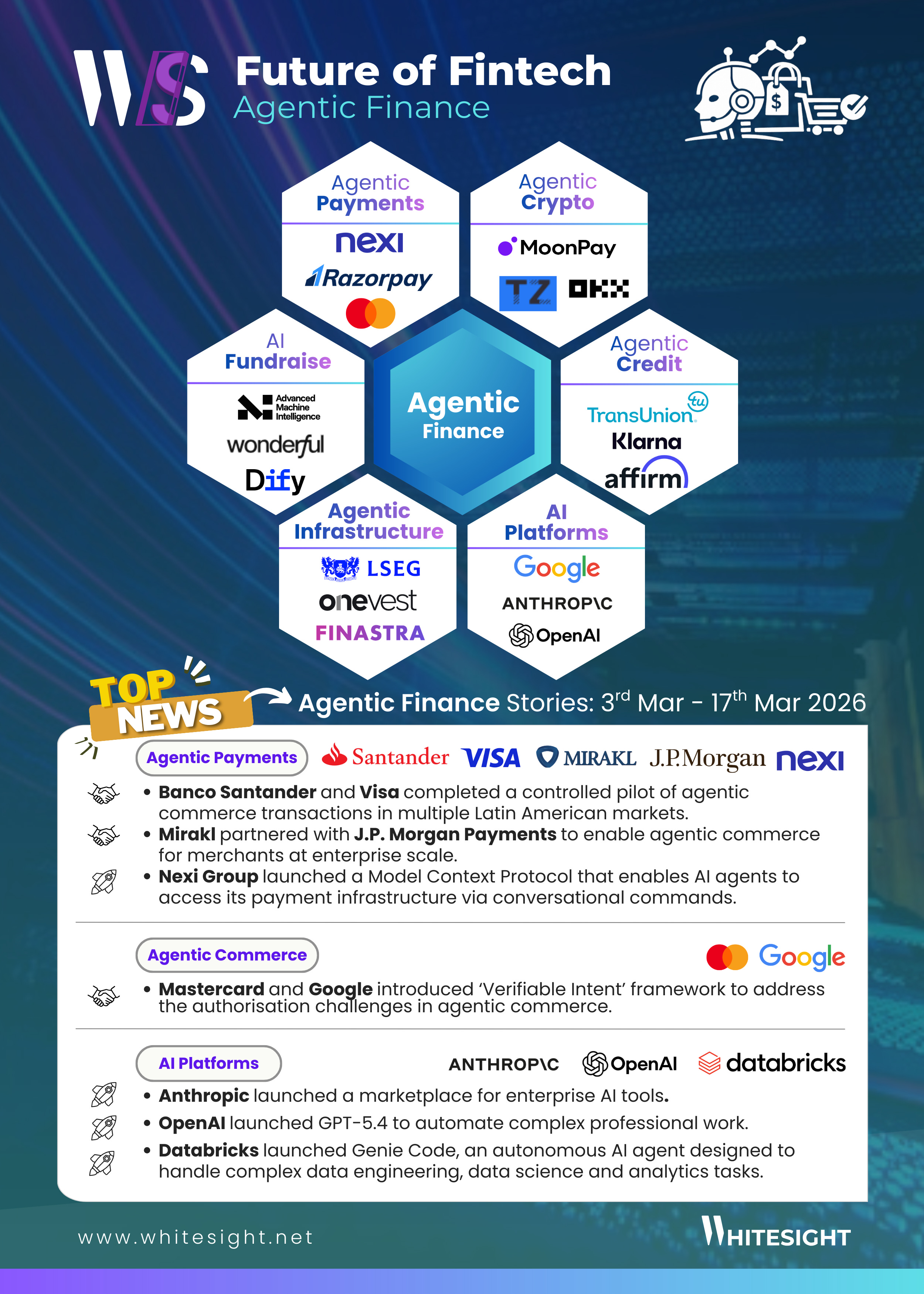
Agentic Payments
⤷ Santander and Visa successfully ran a controlled trial of AI-driven commerce transactions across several Latin American regions.
⤷ Mirakl collaborated with J.P. Morgan Payments to support merchants with enterprise-grade AI-enabled commerce capabilities.⤷ Nexi Group introduced a Model Context Protocol, allowing AI agents to interact with its payment systems through conversational inputs.
Agentic Commerce
⤷ Mastercard partnered with Google to launch a ‘Verifiable Intent’ framework aimed at improving trust and authorization in AI-driven commerce.
AI Platform Updates
⤷ Anthropic rolled out a dedicated marketplace designed to provide enterprises with access to AI tools and solutions.
⤷ OpenAI introduced GPT-5.4, targeting automation of complex, high-skill professional tasks across industries.⤷ Databricks unveiled Genie Code, an autonomous AI agent built to manage advanced data engineering, analytics, and data science workflows.
Now, for the ‘byte’-sized fintech buzz –
Agentic payments advanced as AI agents expanded into enterprise finance workflows and card network-led ecosystem readiness programmes
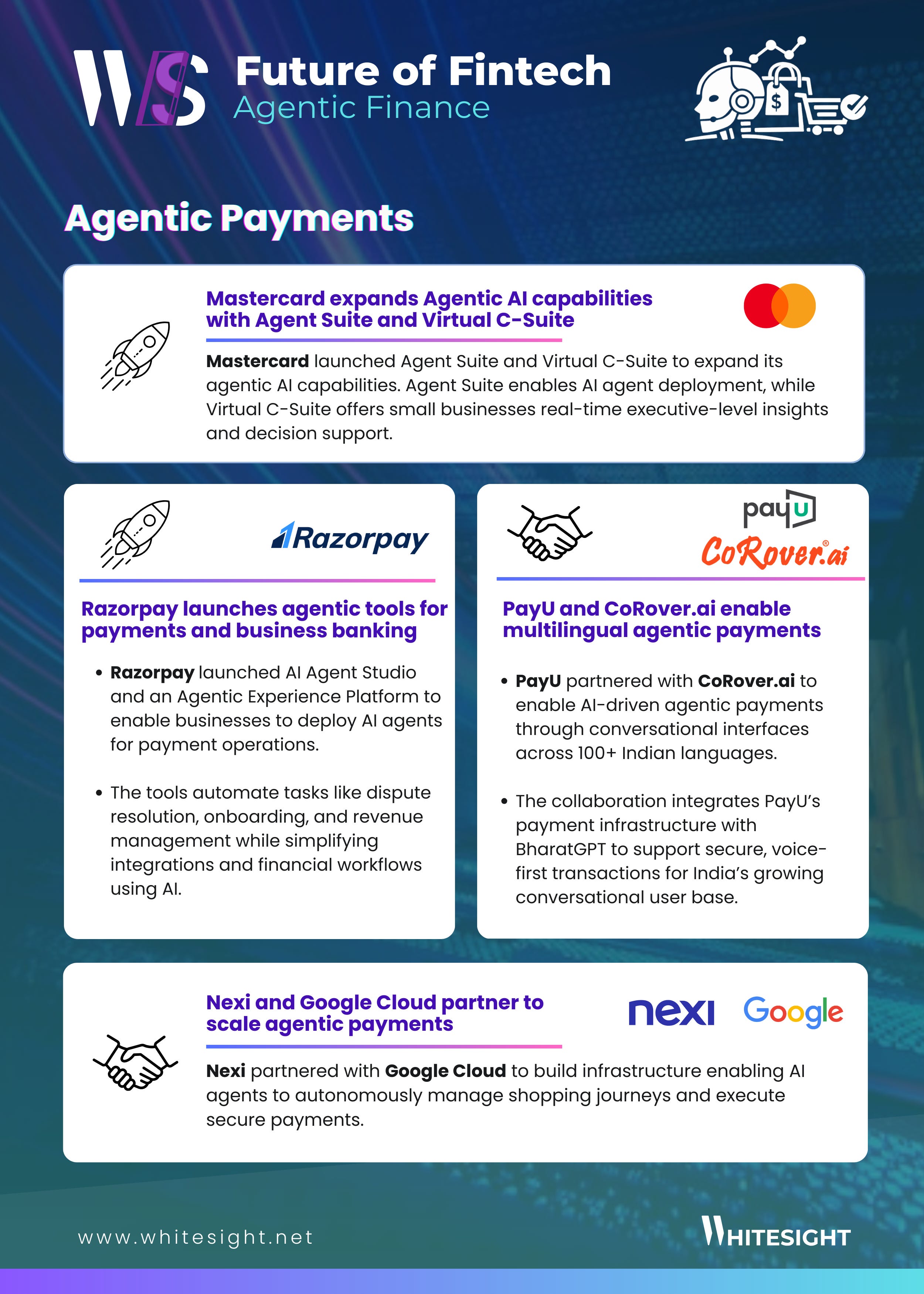
Payhawk launches AI agents for automated invoice retrieval
Payhawk introduced AI agents that autonomously collect invoices from vendor portals and process them within finance systems.
Industry implications: Automating invoice retrieval highlights agentic payments extending beyond checkout into back-office finance and operational workflows.
Visa launches agentic payments programme in Europe
Visa rolled out “Agentic Ready” in Europe to help issuers test and validate AI-initiated transactions at scale.
Industry implications: Visa’s programme signals networks formalising infrastructure for agent-led payments, embedding trust, authentication, and scalability into existing rails.
Agentic crypto progressed as blockchain networks and exchanges enabled AI agents to transact and trade autonomously.
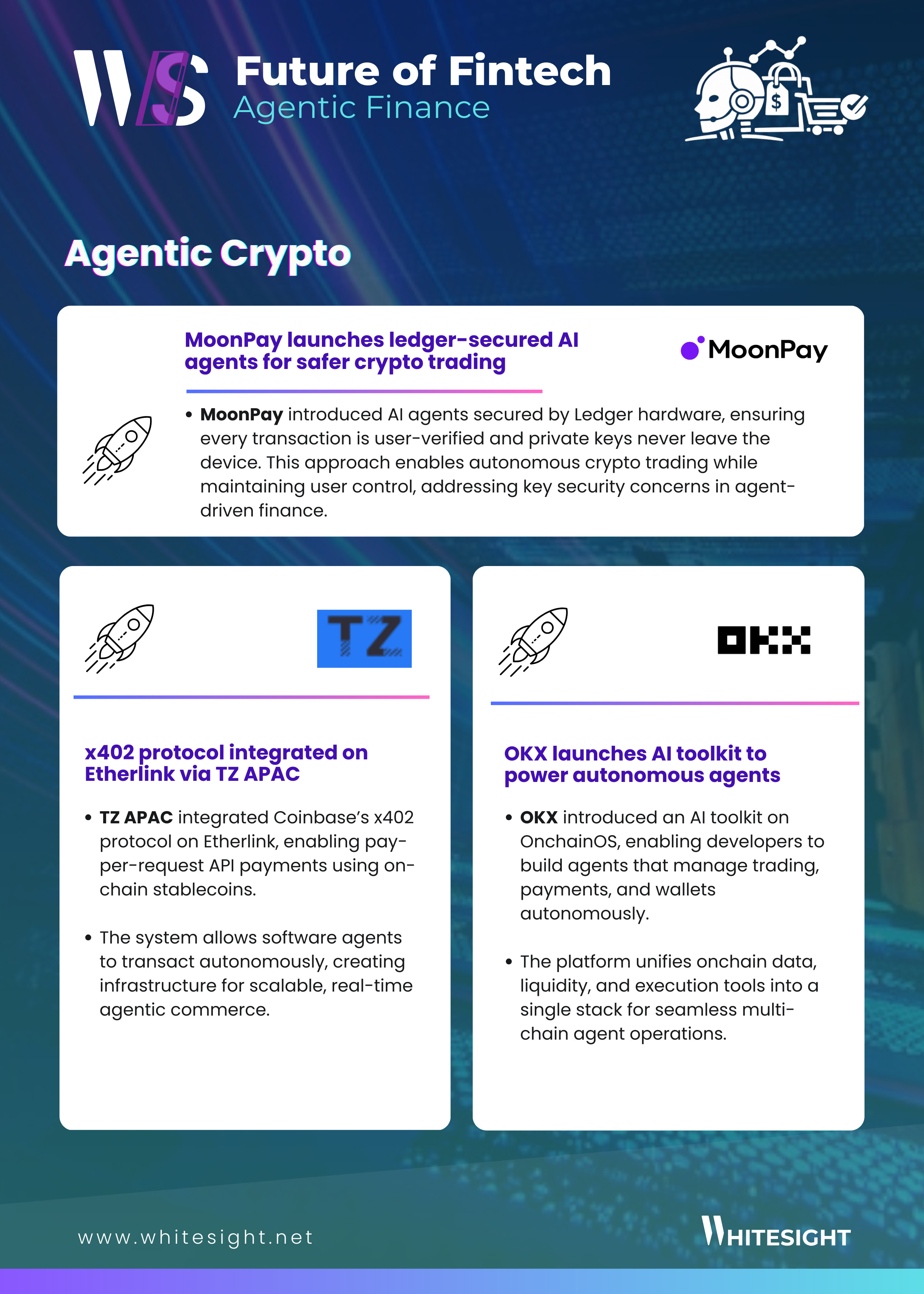
TRON joins Agentic AI Foundation to support open AI infrastructure
TRON became a governing member of the Agentic AI Foundation, advancing open standards for autonomous AI systems and transactions.
Industry implications: This move positions blockchain networks as settlement layers for AI agents, enabling high-frequency, low-cost machine-driven transactions at scale.
Bybit launches AI trading skill for agentic crypto execution
Bybit introduced an AI trading skill allowing users to execute trades, manage assets, and access data via natural language commands.
Industry implications: AI-native trading interfaces signal a shift toward autonomous portfolio management, reducing reliance on manual trading tools and complex interfaces.
Agentic credit evolved as AI systems embedded into lending workflows, automating decisioning, servicing, and borrower engagement
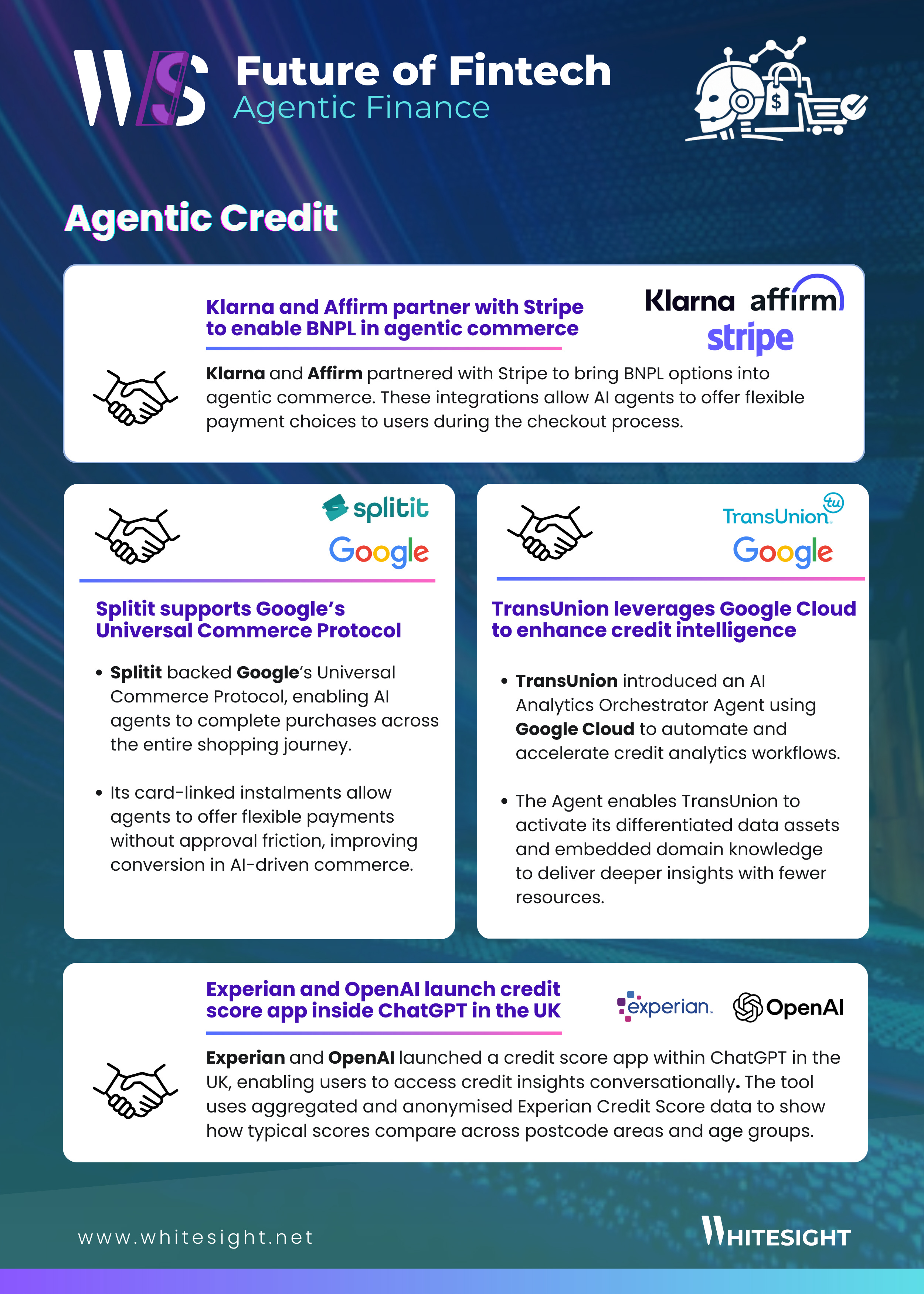
Eltropy launches agentic AI platform for credit unions
Eltropy introduced a governed AI platform enabling credit unions to build, deploy, and manage agents across lending and servicing workflows.
Industry implications: Centralised agent governance signals lenders prioritising compliance, auditability, and controlled automation across credit lifecycle operations.
Algebrik AI integrates with TransUnion for smarter lending
Algebrik AI partnered with TransUnion to embed bureau data directly into its AI-powered loan origination platform.
Industry implications: Embedding credit bureau intelligence into AI workflows enables faster underwriting, improved risk assessment, and more inclusive lending decisions.
AI platform innovation continued as providers focused on securing agentic systems and enabling enterprise-grade autonomous workflow execution.
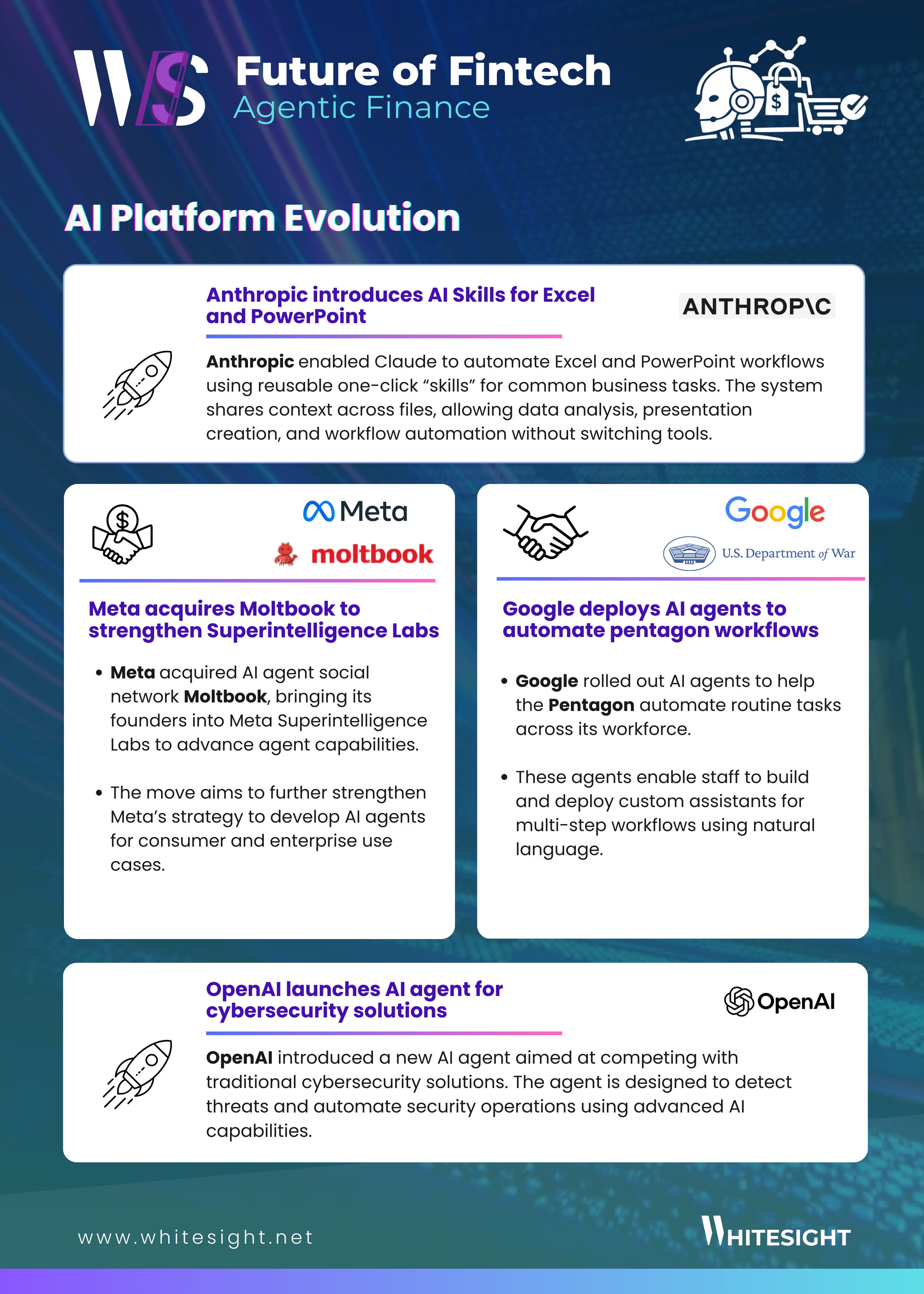
OpenAI plans acquisition of Promptfoo to secure agentic AI systems
OpenAI announced plans to acquire Promptfoo, integrating automated testing, red-teaming, and risk monitoring into its Frontier agent platform.
Industry implications: This signals security becoming foundational to agentic AI, embedding governance, compliance, and risk controls directly into development workflows.
Colt and Microsoft develop agentic AI engine for enterprise workflows
Colt partnered with Microsoft to build an AI engine automating enterprise quoting processes and reducing response times.
Industry implications: Enterprise AI is shifting toward autonomous execution, replacing manual workflows with agent-driven systems embedded across business operations.
Agentic infrastructure advanced as compliance and security layers adapted to support autonomous AI-driven financial and commerce workflows
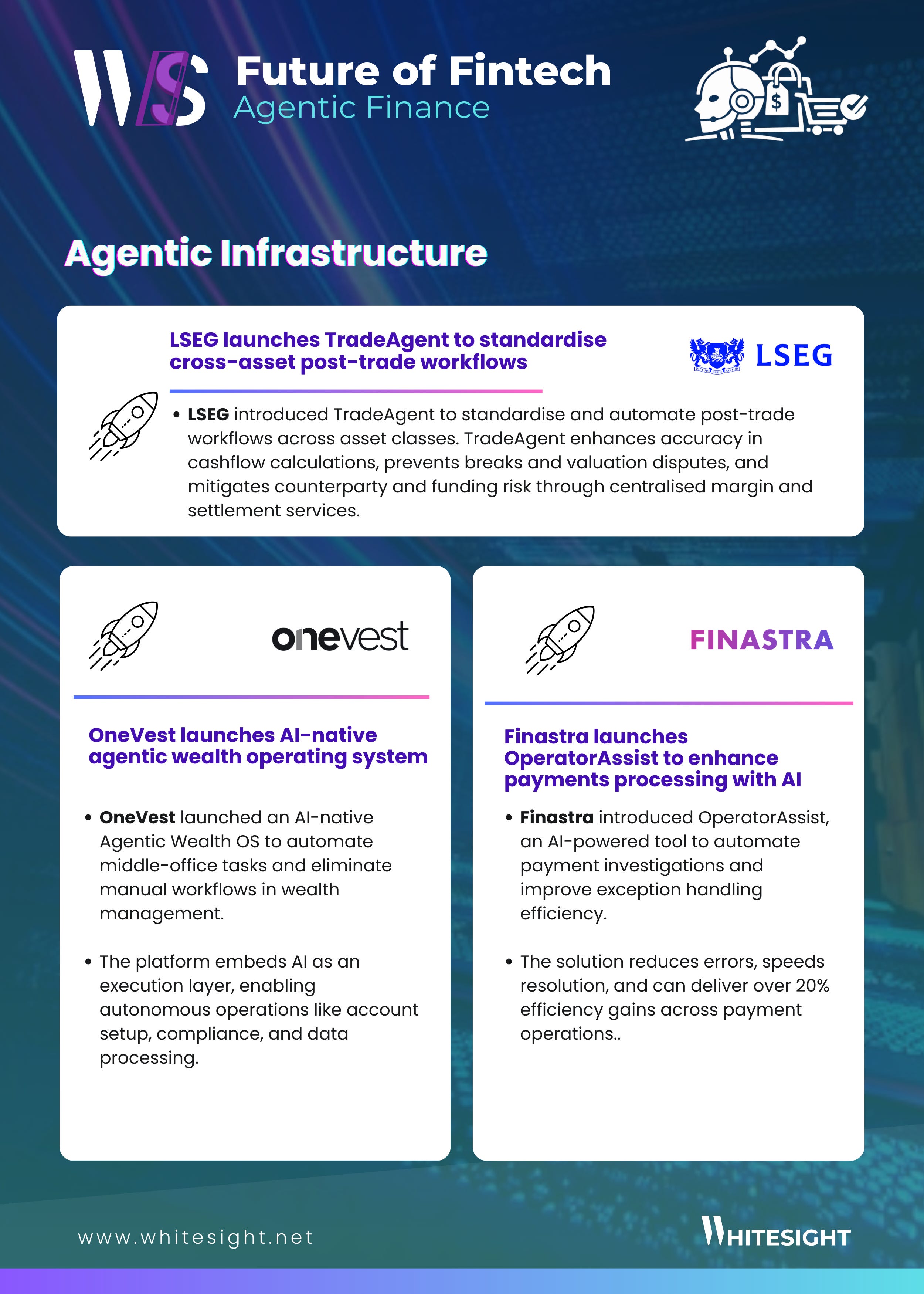
iDenfy launches AI reviewer for automated KYB onboarding
iDenfy introduced an AI reviewer that automates business verification by cross-checking documents, registries, and compliance signals in real time.
Industry implications: Automating KYB processes highlights how agentic infrastructure is reducing manual compliance overhead while improving speed, consistency, and auditability.
Darwinium launches intent-based authentication for agentic commerce
Darwinium released an authentication framework that evaluates agent intent and behavior to distinguish trusted AI activity from malicious automation.
Industry implications: Intent-based security signals a shift toward real-time trust frameworks, enabling safe scaling of AI agents across financial and commerce ecosystems.
Funding continued to flow in agentic infrastructure as startups building enterprise AI operating layers secured early-stage investment
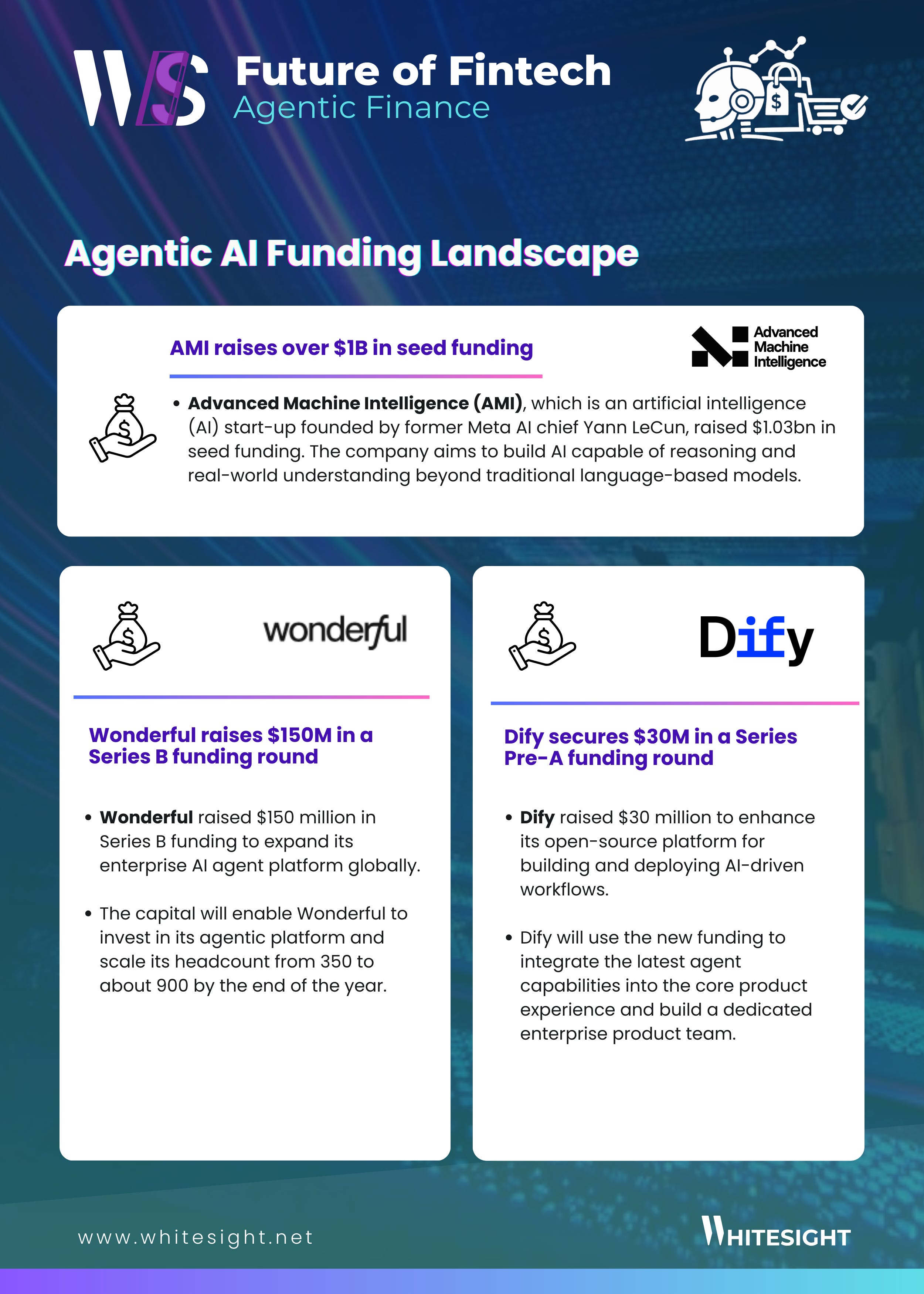
Handle raises $6 million to expand enterprise AI agent platform
Handle secured $6 million in funding to scale its AI agent platform targeting enterprise operations, initially focusing on insurance workflows.
Industry implications: Funding highlights investor confidence in agentic platforms as core enterprise infrastructure, automating complex workflows across industries and functions.
And that’s a wrap 👋
We hope you enjoyed this edition of the Agentic Finance Brew!
As a reward for making it this far, here’s a curated set of agentic resources to keep your curiosity (and conviction) topped up. Cheers to continuous learning!
Link Up! –
Supply Chain Financing: Durable Global Trade in the Age of AI - CITI
Agentic AI untangled: Navigating the build, buy, or borrow decision - KPMG
The automation curve in agentic commerce - McKinsey
How Agentic AI Can Power Core Insurance IT Modernization - BCG
If you’re someone who likes to read think pieces, you will likely love our monthly blog, Fintersections, where our team members analyse the convergence of fintech with the world.
And lastly, to stay updated on everything fintech and web3, follow us on LinkedIn and Twitter, and don’t be shy to show some ❤️
Thanks for reading Future of FinTech Newsletter! Subscribe for free to receive new posts and support my work.