
This month in agentic finance felt like the point where autonomy met payment rails. 🧭
Banks, payment networks, and fintechs moved beyond copilots and pilots, deploying agentic systems that could investigate risk, execute transactions, and complete commerce flows inside regulated environments.
✔ Agentic payments moved from concept to live card transactions across major banks
✔ AI agents got their own infrastructure, from payment APIs to blockchain identities to AML investigation suites
✔ Standards and alliances emerged to make agentic commerce interoperable
Ready for the agentic signals that mattered in January? 🔍⚡
🚨 Featured Story of the Week:
Google Introduces the Universal Commerce Protocol (UCP)
Google launched UCP, allowing AI agents to handle shopping from discovery to post-purchase without custom integrations.
Google co-developed UCP with Shopify, Etsy, Wayfair, Target, and Walmart. It has also secured endorsements from 20+ global players across payments, including Visa, Mastercard, Stripe, Adyen, and Walmart.
Klarna became the latest member to join UCP, extending its existing partnership with Google across Google Pay, Google Cloud, and the Agent Payments Protocol (AP2).
What changes now
AI agents (e.g., Google’s Gemini) can query merchant inventory, build carts, and complete payments using UCP primitives, without bespoke engineering for every store or payment partner.
UCP standardizeds how agents request pricing, calculate totals, and initiate checkout, allowing integrated payment flows that financial products (cards, wallets, BNPL) can support natively.
Platforms built on Shopify, BigCommerce, and major retail chains automatically gained a path to be usable by agentic systems, reducing integration overhead.
Why this matters for financial players
By defining a common protocol, Google and partners helped ensure that commerce and payments can be realized by agents without each fintech reinventing connectivity.
Payment and settlement can be exposed to agents in controlled ways
Cards, wallets, and BNPL can be orchestrated by AI agents with standardized APIs
Agents can orchestrate value movement instead of merely recommending actions
If agents are becoming the interface to money and commerce, UCP became one of the first serious attempts to define the rails they run on!
Thanks for reading Future of FinTech - Agentic AI Newsletter! Subscribe for free to receive new posts and support our work.
Thanks for reading Future of FinTech Newsletter! Subscribe for free to receive new posts and support our work.
🚀 Startup Spotlight: Resistant AI
This edition, we’re shining a light on Resistant AI, an AI-native fraud detection and financial crime prevention platform.

The pitch is simple: instead of ripping out legacy systems, firms can plug in modular AI agents and use an agentic assistant to orchestrate tasks end-to-end, lowering operational cost while strengthening controls and scalability.
Got something cool brewing in agentic finance? We’d love to feature you next- drop us a note at hello@whitesight.net 👋
Pledge your access to fintech analysis and exclusive insights ⚡
What’s on the fintech menu today?
🏁 Agentic Highlights: Biggest moves across agentic payments, agentic banking, and agentic commerce
🧩 ‘Byte’ Buzz: Agentic Finance updates, sorted by segment
🔗 Link Up: A curated set of reads worth your time
Sip on bite-sized agentic updates - fresh, sharp, and distilled to keep you ahead in just minutes. Subscribe now! 📨
📢 We’re always seeking innovative voices in fintech to be our next guest feature!
With a community of 2100+ fintech enthusiasts, we’d love to amplify your insights. Reach out to us for features, sponsorships, or collaborations!
Get Unlimited Access to Strategy Playbooks of Fintech Pioneers with WhiteSight Radar! 🚀

Unlock a treasure trove of fintech intel with a WhiteSight Radar subscription. See further with exclusive reports, industry trend breakdowns, and expert analysis on everything from Embedded Finance and Digital Banking to Open Finance and beyond.
Become a member and steer your business course with actionable intelligence on the winning strategies of leading companies like Apple, Stripe, Starling Bank, OakNorth Bank, Banco Inter, and Toast that propels your business to the forefront of fintech. (PLUS! More in our premium content pipeline - Amazon, Nubank, Grab, Wise, Shopify, Affirm, Mercado Libre… the list goes on!)
Supercharge your Fintech IQ with WhiteSight Radar, putting expert fintech intel at your fingertips! 🧭
Edition 1 brings you the agentic finance stories that shaped how agents shaped the finance and fintech industry in January »
January’s Top Agentic Tea!♨️
Agentic Payments
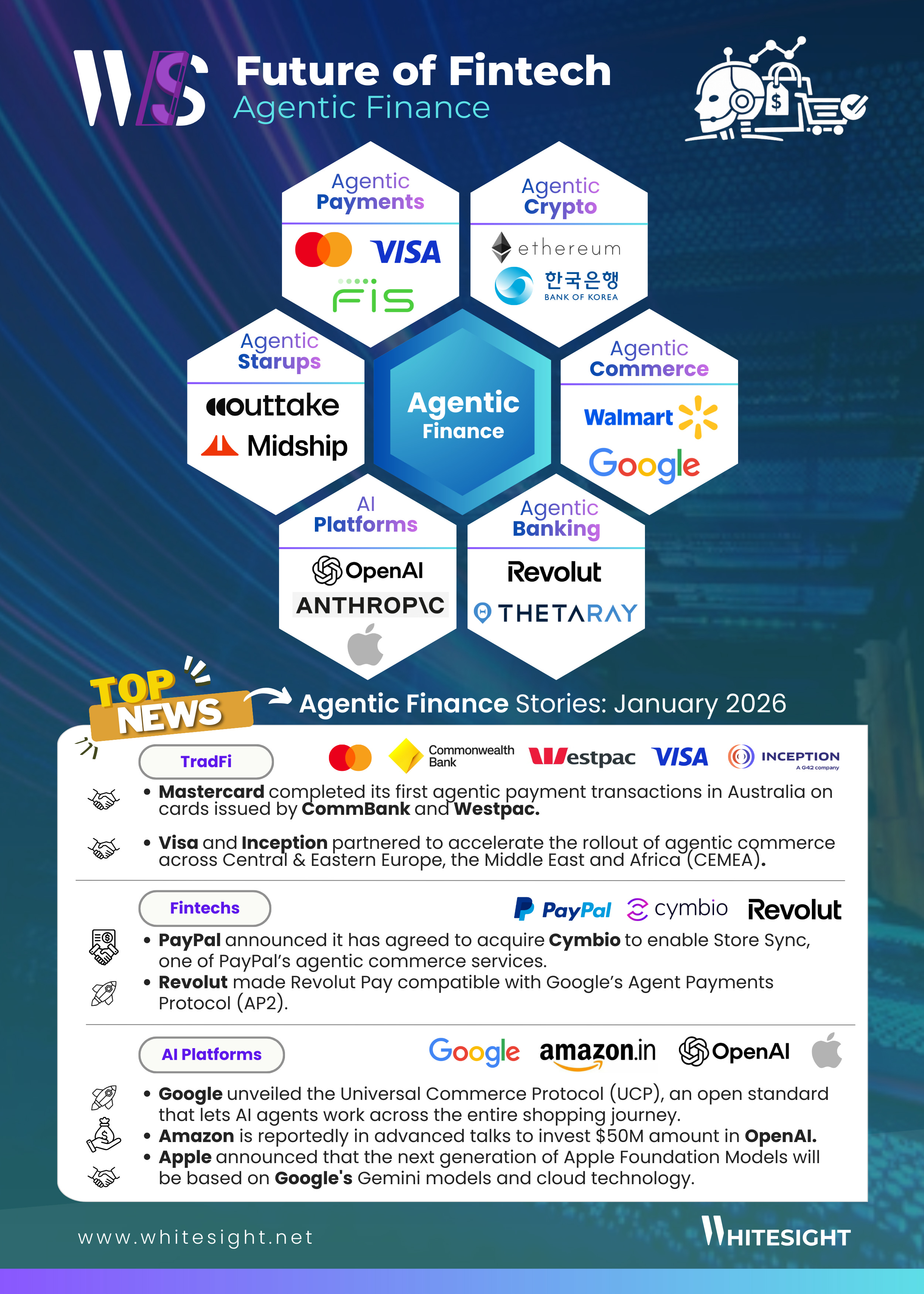
⤷ Mastercard completed Australia’s first agentic payment transactions using its Agent Pay technology, where AI agents can shop and pay on behalf of consumers.
⤷ Visa and Inception partnered to accelerate the rollout of agentic commerce across Central & Eastern Europe, the Middle East and Africa (CEMEA) by integrating Visa Intelligent Commerce into agentic commerce solutions.
Agentic Banking
⤷ Revolut made Revolut Pay compatible with Google’s Agent Payments Protocol (AP2), positioning it to support secure agent-initiated, AI-led payments across agentic commerce platforms in the UK and European Economic Area.
AI Platform Updates
⤷ Google unveiled the Universal Commerce Protocol (UCP), an open standard that lets AI agents work across the entire shopping journey, from discovery to purchase to post-sale support.
⤷ Amazon is reportedly in advanced talks to invest $50M amount in OpenAI, as part of a broader capital-raising effort by OpenAI ahead of a possible future IPO.⤷ Apple and Google entered a multi-year partnership where Apple’s next-generation Foundation Models will be based on Google’s Gemini models and cloud technology.
Now, for the ‘byte’-sized fintech buzz –
Agentic payments saw card networks and core processors start wiring “shopping agents” into payment rails.
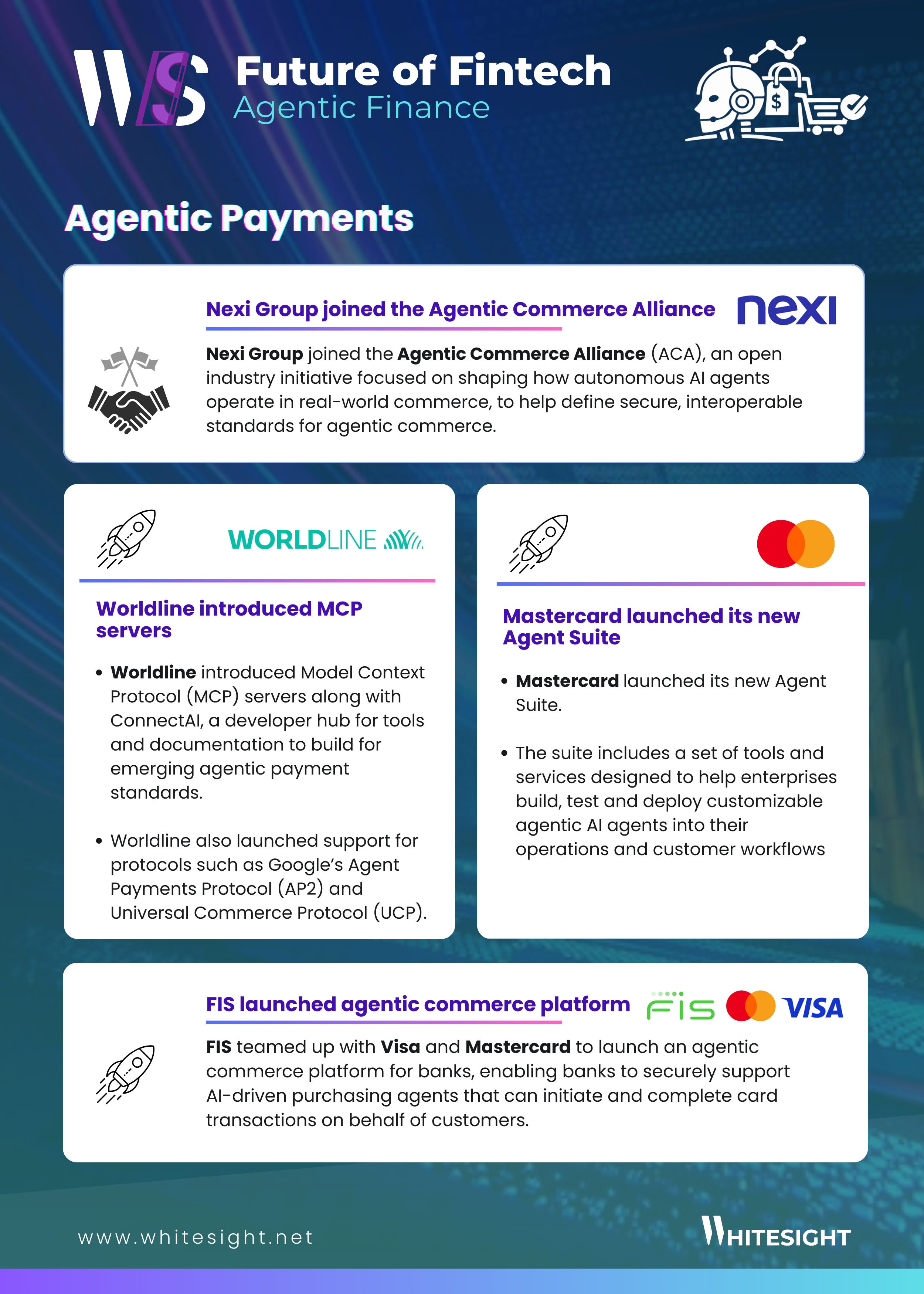
Mastercard launches Agent Suite:
Mastercard launched a specialized suite of tools designed to provide the underlying infrastructure for AI agents to authorize and execute payments autonomously. The suite includes digital “Agent Credentials” and spending-limit controls that allow businesses to delegate financial authority to AI agents while maintaining strict security protocols.
Industry implications: This launch fits into the broader industry trend of networks starting to productize agent readiness, including identity, controls, security, and orchestration, so agent-led transactions could scale without breaking trust and fraud protections.
FIS integrates agentic commerce capabilities into the global banking ecosystem
FIS partnered with Visa and Mastercard to enable banks to participate in agentic commerce, positioning issuers to work with AI shopping agents.
Industry implications: Issuers are pushing to keep top-of-wallet status by adding fraud checks, KYA-style signals, and authorization controls around agent-driven checkout flows.
Agentic Crypto rails started formalizing agent identity and machine-executable standards so autonomous agents could transact and settle on-chain.
Ethereum brings AI agent economy standard on mainnet
Ethereum introduced ERC-8004 to the mainnet to support AI agents interacting with entities on Ethereum and participating in an agentic economy.
Industry implications: Standards for agent interaction are shifting from app-level conventions to protocol-level primitives, enabling more portable, composable agent activity across on-chain venues.
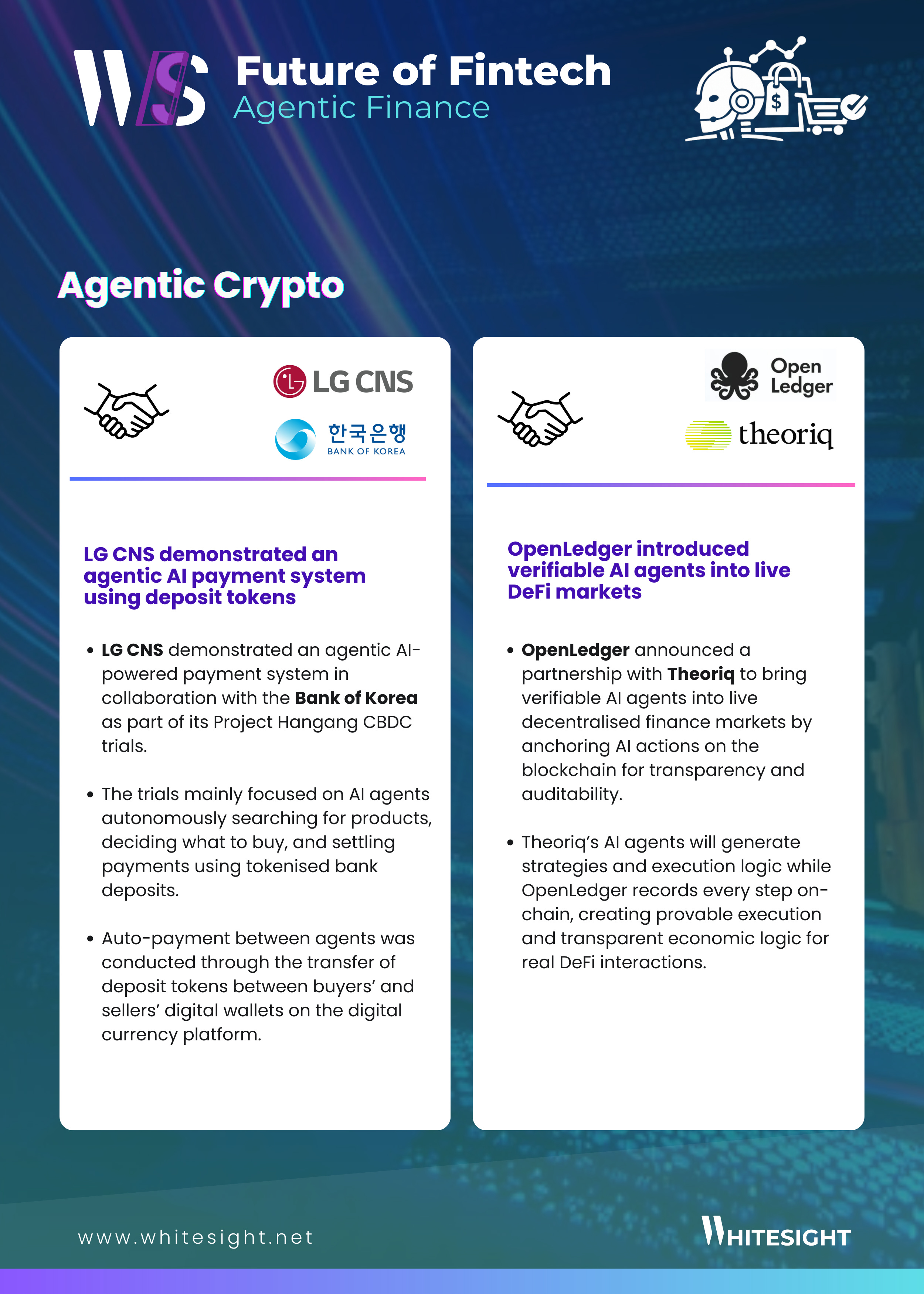
LG CNS introduces agentic AI auto-payment with digital currency
LG CNS and the Bank of Korea demonstrated Korea’s first agentic AI-based digital currency auto-payment, where AI handled search-to-purchase-to-payment.
Industry implications: Digital currency pilots are increasingly being tested for agent-driven purchase and payment automation, raising new needs for limits, authorization, and audit trails.
Agentic banking trends show that banking operations are evolving from automated workflows to autonomous decision-making units.
ThetaRay launches investigation suite
ThetaRay launched Ray, an agentic AI investigation suite to automate and standardize transaction monitoring investigations amid rising alerts and regulatory scrutiny.
Industry implications: Compliance is shifting towards structured, explainable, regulator-ready workflows where agents assemble narratives and evidence while analysts retain control.
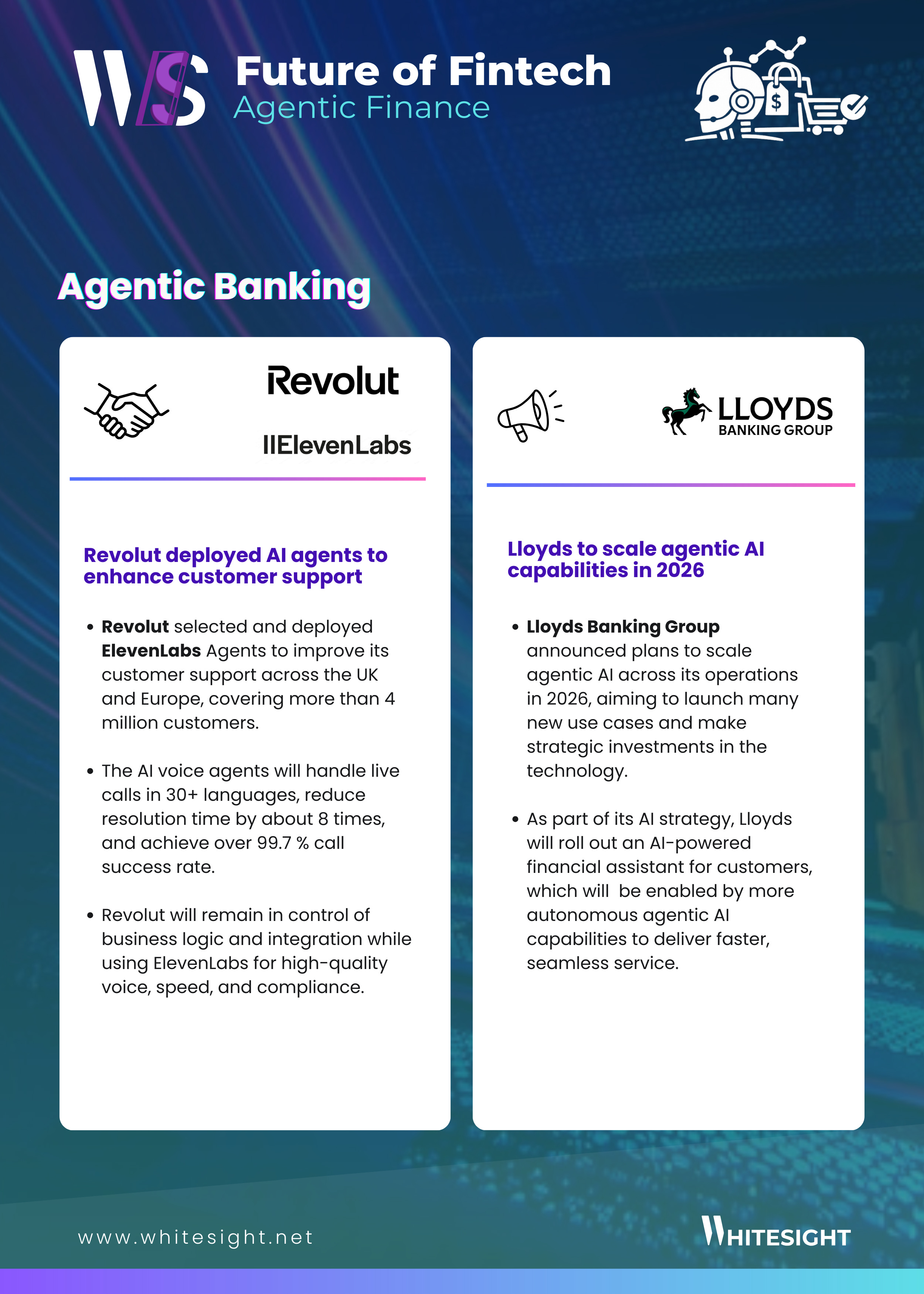
Revolut introduces AI voice agents in customer support
Revolut deployed ElevenLabs Agents for customer support across the UK and Europe, covering 4M+ customers, 30+ languages, and cutting resolution time by 8x+.
Industry implications: Digital banks and fintechs have started treating voice agents as a production channel, increasing the bar for compliance, monitoring, and safe-handling of sensitive customer interactions.
Agentic commerce trends show that retail is moving away from a search and click model toward a delegated intent model.
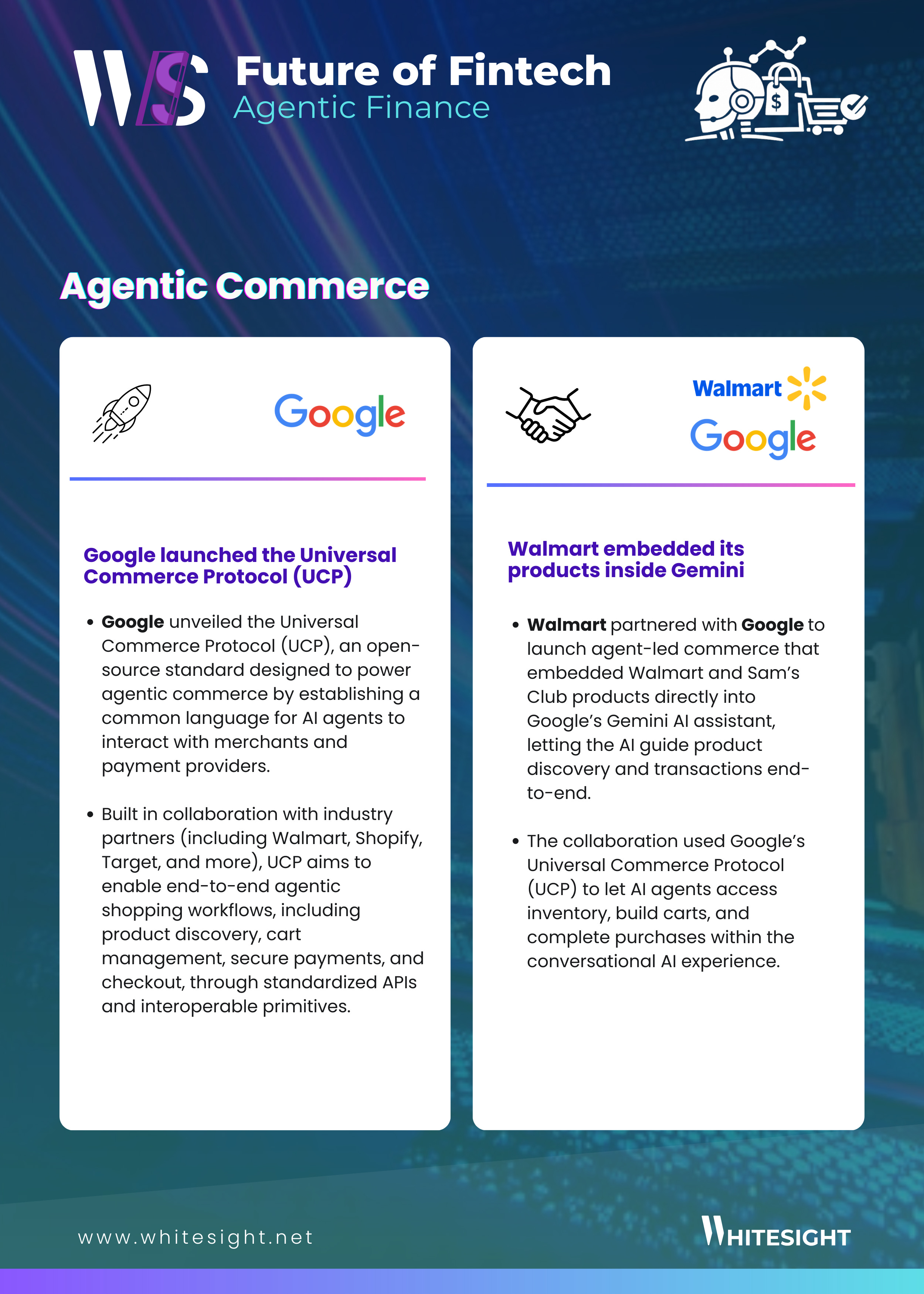
Google powers Walmart’s agentic commerce aspirations
Walmart partnered with Google to embed Walmart andSam’s Club inventory into Gemini, supporting agent-led shopping and transactions.
Industry implications: Merchants are moving on to agent-accessible surfaces so they can capitalise on distribution when AI agents choose where to buy.
AI platforms are pushing agentic adoption through vertical-first products that emphasize secure deployment and operational integration.
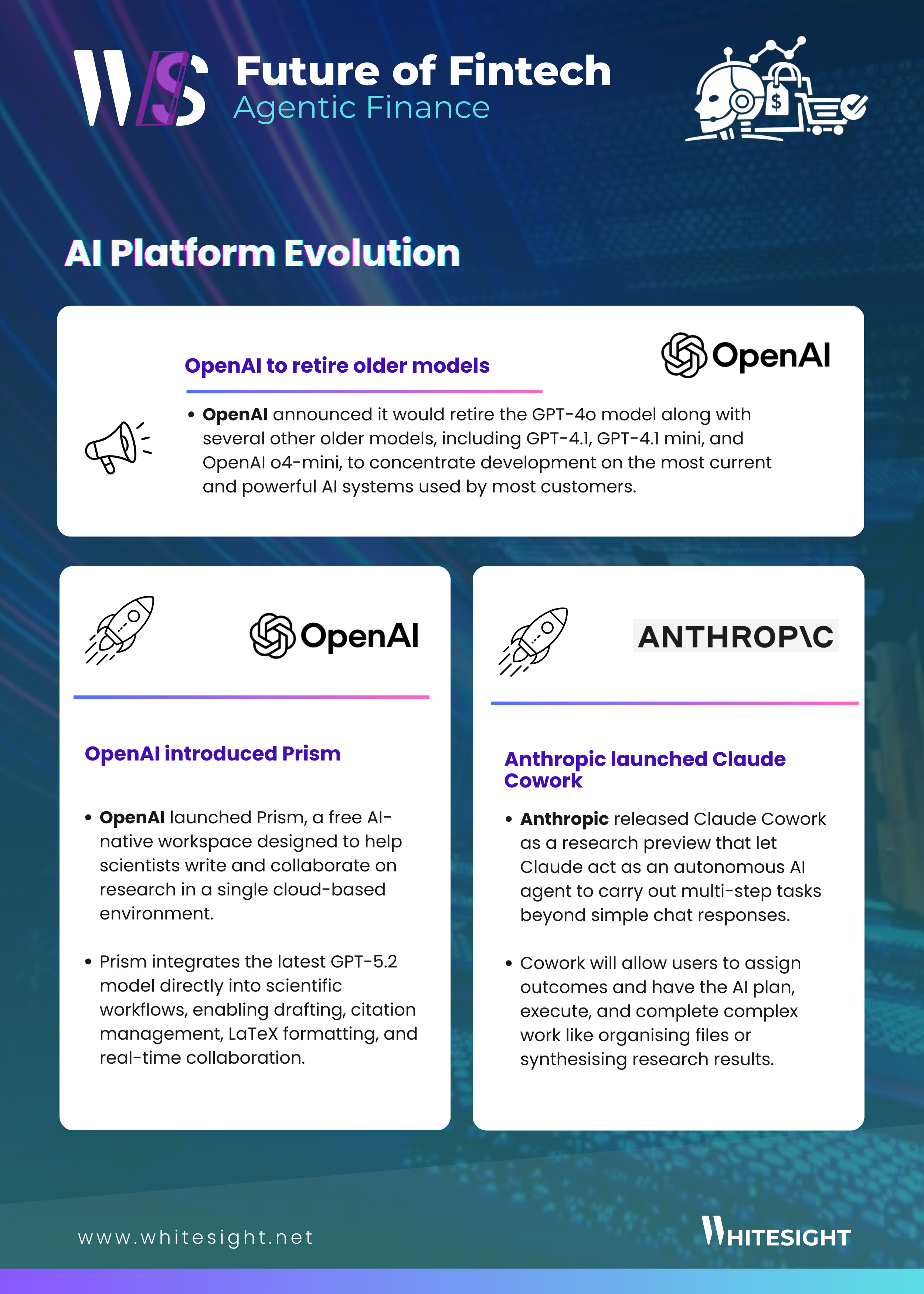
OpenAI launches ChatGPT Health
OpenAI launched ChatGPT Health, a dedicated service to securely connect health data and apps, with privacy controls and a phased rollout.
Industry implications: AI platforms are accelerating domain workspaces that bundle data connections and controls, setting expectations that future agentic products must ship with privacy, governance, and integrations locked in.NTT DATA and AWS scale enterprise agentic AI adoption
NTT DATA and AWS expanded a strategic collaboration to accelerate enterprise cloud modernization and responsible agentic AI adoption at scale.
Industry implications: The market is shifting from pilots to industrialization, with systems integrators and hyperscalers packaging reference architectures, compliance patterns, and talent pipelines for agent deployments.
Regulatory bodies are proactively establishing frameworks that emphasize human accountability and fair competition.
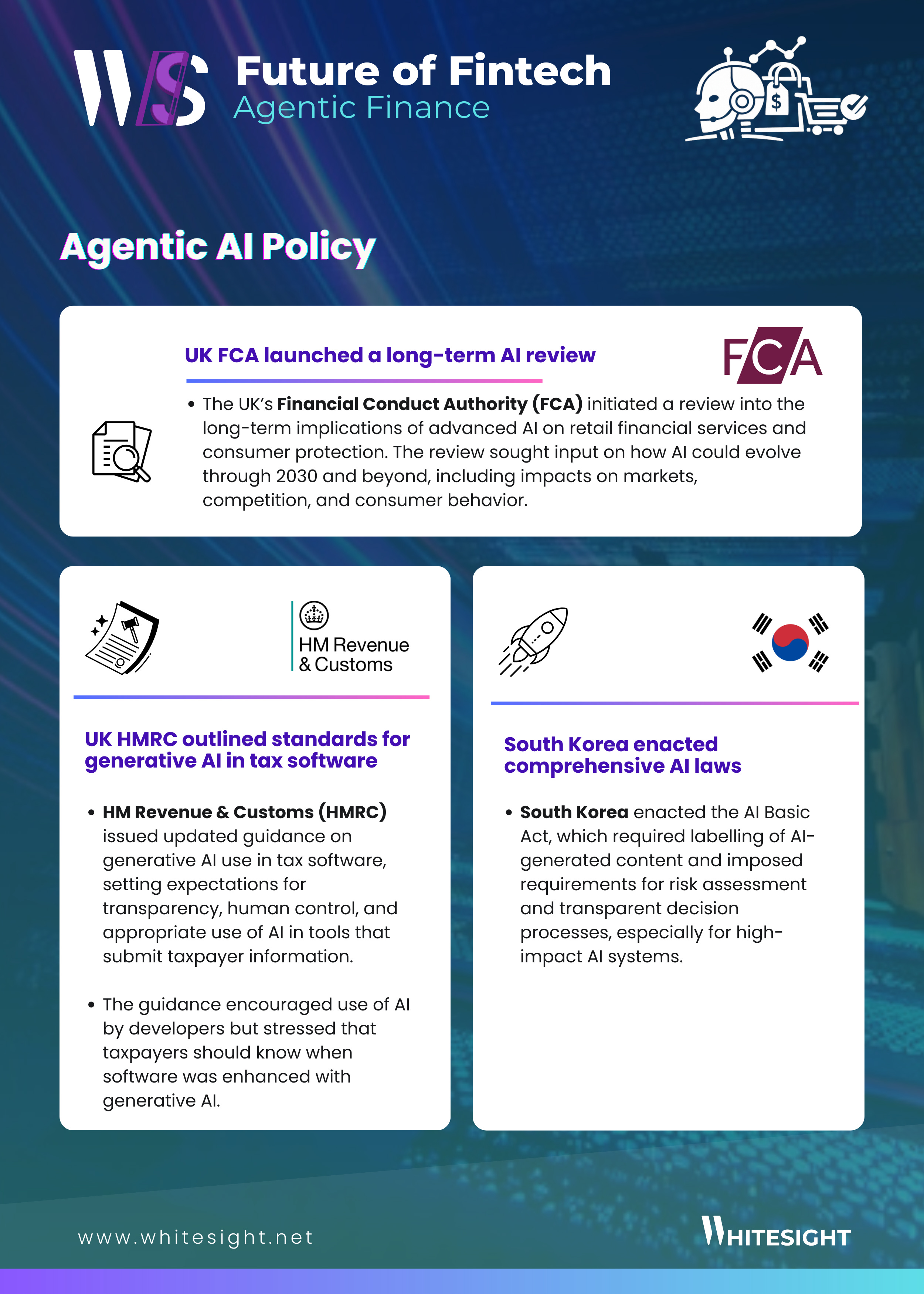
UK HMRC setting standards for genAI in tax software
HMRC issued guidance for commercial tax software providers on the appropriate use of generative AI in tools that support submissions to HMRC.
Industry implications: Software providers are facing clearer accountability expectations, signaling a move toward use-case-specific AI rules rather than generic principles.
South Korea introduces the AI Basic Act
The South Korean government has passed a landmark “AI Startups Law” aimed at protecting smaller innovators in the agentic economy from being crowded out by tech giants.
Industry implications: National AI regimes are increasingly creating operational requirements that directly affect how agentic products are shipped and scaled.
And that’s a wrap 👋
We hope you enjoyed this edition of the Agentic Finance Brew!
As a reward for making it this far, here’s a curated set of agentic resources to keep your curiosity (and conviction) topped up. Cheers to continuous learning!
Link Up! –
Agentic AI Payments: Navigating Consumer Protection, Innovation, and Regulatory Frameworks - Consumer Bankers Association (CBA)
AI Agent Trends 2026 - Google
The human advantage: Stronger brains in the age of AI - McKinsey
If you’re someone who likes to read think pieces, you will likely love our monthly blog, Fintersections, where our team members analyse the convergence of fintech with the world.
And lastly, to stay updated on everything fintech and web3, follow us on LinkedIn and Twitter, and don’t be shy to show some ❤️
Thanks for reading Future of FinTech Newsletter! Subscribe for free to receive new posts and support my work.
Excellant roundup of agentic finance developments. The Mastercard Agent Pay trials in Australia are a pretty big signal that this is moving from concept to production. Whats really cool is how UCP creates that common protocol layer so agents dont have to reinvent integration for every merchant. The compliance side with ThetaRay's investigation suite is crucial tho because regulatory scrutiny is gonna be intense. Looking forward to seeing how these standards evolve over the next few months.